Designing a Future Worth Playing
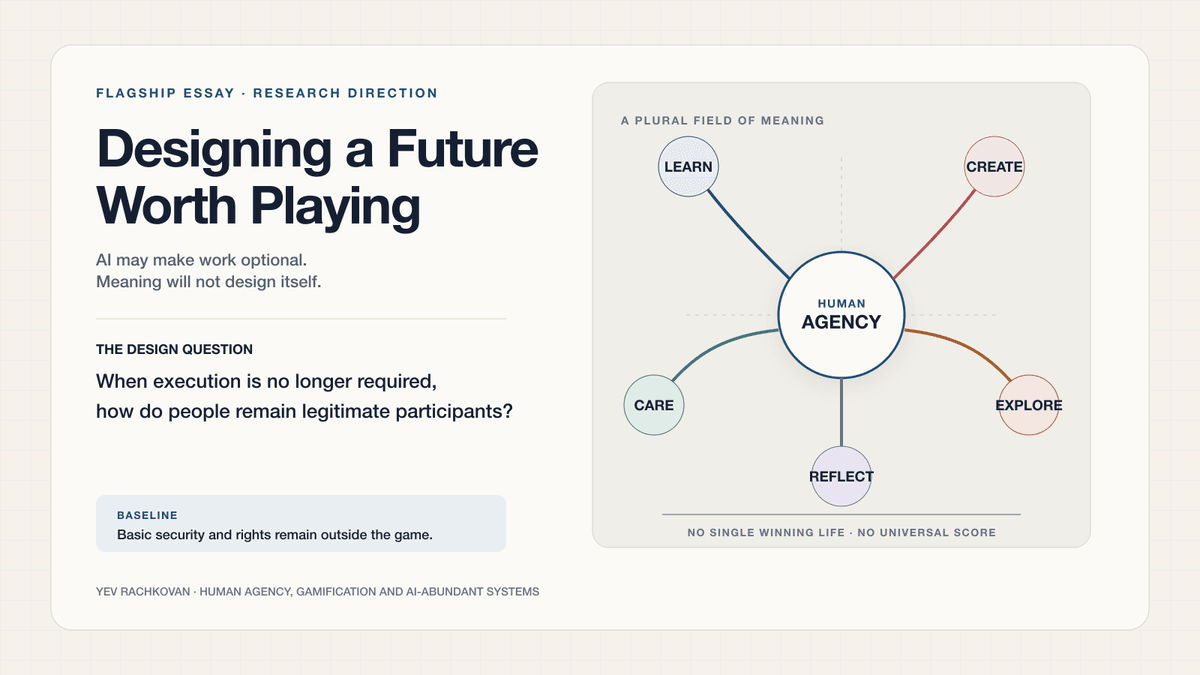
AI may make work optional. Meaning will not design itself.
For a brief period, I lived inside a small, imperfect version of abundance.
I had a flexible CTO role, a comfortable home, food delivered, massages, recognition, and more freedom than I knew how to use. AI was writing most of the code. I could describe a feature, let agents implement it, and move on to the next idea.
From the outside, this looked like winning.
Then I looked at what I had built. I had around fifteen features that were all supposedly 90% complete. None of them truly worked. My reaction was simple: this is garbage.[19]
The missing thing was not another productivity tool. I no longer knew how to fit myself into a system where AI did things better and faster than I did. As I stopped implementing, I understood less. As I understood less, my attempts to control the work felt less useful. Eventually I gave up on control because, without understanding, I seemed to be nothing more than a bottleneck.
That experience changed the question I ask about AI.
The question is not only: What can machines do for us?
It is also: How does a person remain a legitimate participant when the system no longer needs their execution—and their intervention may make it worse?
This is not a distant post-AGI thought experiment. It has already happened to me on a small scale.
AI may solve production without solving participation
For most of my career, I used gamification to make people participate.
At Scrimmage, we built quests, levels, rewards, and loyalty economies. In education, I worked on games and progress systems for students. In my own life, I turned goals into quests, skills into levels, and experiences into a story I could inspect.
I assumed the problem was motivation: how do we help people do the things they need or want to do?
AI may invert that problem.
If machines eventually run most companies, produce essential goods, and operate large parts of government, people may no longer need to work to secure a decent life. I do not know when this will happen. It may arrive slowly, unevenly, or not at all. Current evidence shows broad exposure of work to AI, not proof of mass unemployment. The International Labour Organization estimates that one in four workers is in an occupation with some generative-AI exposure, but only 3.3% of global employment falls into its highest exposure category. Its conclusion is that job transformation is more likely than simple replacement.[1]
That uncertainty should not stop us from asking what comes next.
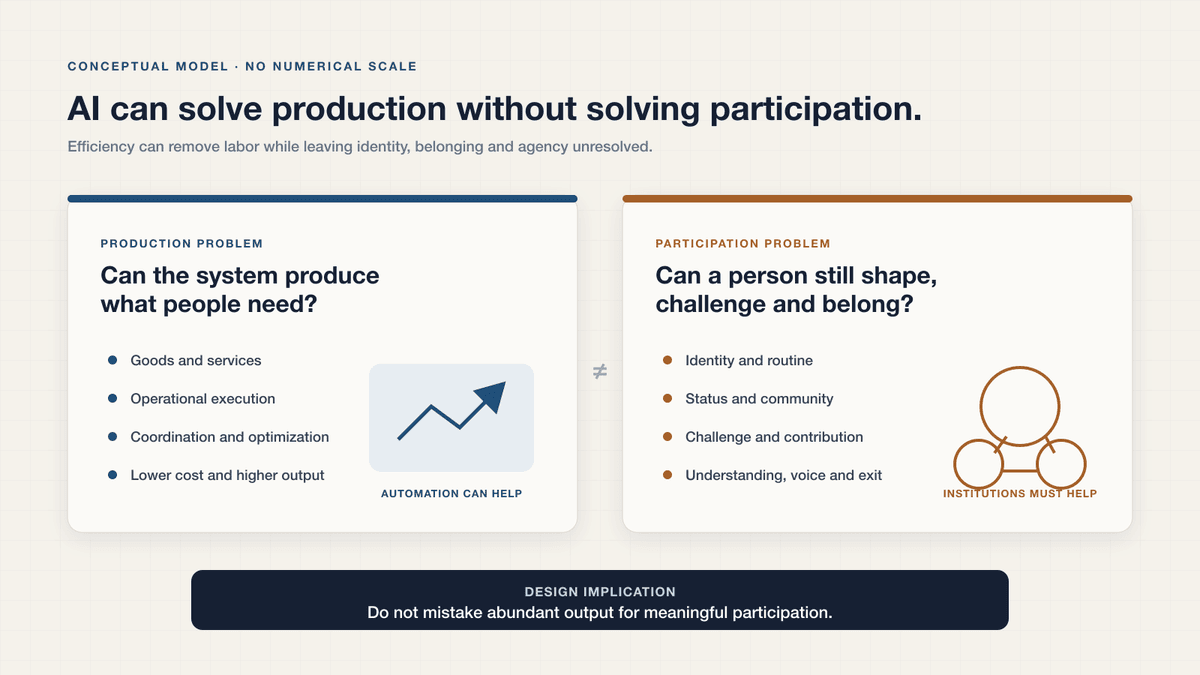
The usual debate is about which jobs AI will take. I care about the structure that jobs currently provide: identity, routine, status, community, challenge, contribution, and visible progress.
AI may solve much of the production problem without solving the participation problem.
Abundance does not mean infinite resources
When I speak about abundance, I do not mean that everything becomes free or physically unlimited.
Land remains limited. Energy still needs generation and a grid. Clean technologies depend on minerals, processing capacity, and concentrated supply chains. Attention, trust, status, political power, and ecological capacity remain scarce. The International Energy Agency estimates that data centers consumed about 415 terawatt-hours of electricity in 2024 and could consume around 945 terawatt-hours by 2030 in its base case.[2] The United Nations Environment Programme projects that, without major changes, global material extraction could rise from 100 billion tonnes in 2020 to 160 billion tonnes in 2060.[3]
AI is not immaterial magic.
The abundance I care about is narrower: a decent standard of living no longer requires most people to sell most of their waking time. Machines perform much of the operational labor. Essential goods and services become cheaper and easier to produce. Humans may still work, compete, build companies, care for families, create art, and explore. Survival simply stops making those activities compulsory.
That would be an extraordinary achievement.
It would also remove one of the main systems through which people currently know where they belong.
Work did more than pay us
I do not want to preserve pointless jobs because we are afraid of life without them. But we should understand what disappears with work before celebrating its disappearance.
Unemployment is consistently associated with worse mental-health outcomes. A meta-analysis covering 237 cross-sectional and 87 longitudinal studies found a substantial association, though it could not isolate the mechanisms.[4] In an older West German panel of men, the non-financial life-satisfaction cost of unemployment was larger than the estimated income-loss component. That is consistent with—but does not prove—roles for identity, relationships, and self-esteem.[5]
That does not mean people need bosses, offices, or compulsory labor to be happy. Research on retirement offers an important counterpoint: when selection effects are addressed, retirement can improve psychological well-being.[6] Sudden wealth can also create durable improvements in life satisfaction, although effects on day-to-day happiness and mental health are smaller.[7]
Cash-transfer evidence shows that income can improve consumption and psychological well-being in specific settings, while effects on work vary by program.[20] It does not, by itself, establish durable purpose or belonging. A recent U.S. guaranteed-income experiment found modest reductions in labor-force participation and working hours; its early subjective well-being gains faded relative to the control group.[8] Alaska's much smaller permanent dividend produced no measurable reduction in aggregate employment in one influential study.[9]
The lesson is not that work is sacred.
The lesson is that income and meaning are different problems.
The pig, the carrot, and the purpose of engagement
Gamification today is usually sold as a tool for conversion, productivity, retention, or compliance.
Complete a task. Maintain a streak. Reach the next tier. Earn a reward. Stay in the app.
I have spent much of my career designing engagement systems, including in sports betting. That experience taught me that engagement has more than one measure of success: participation matters, but so does the value a person receives from taking part.
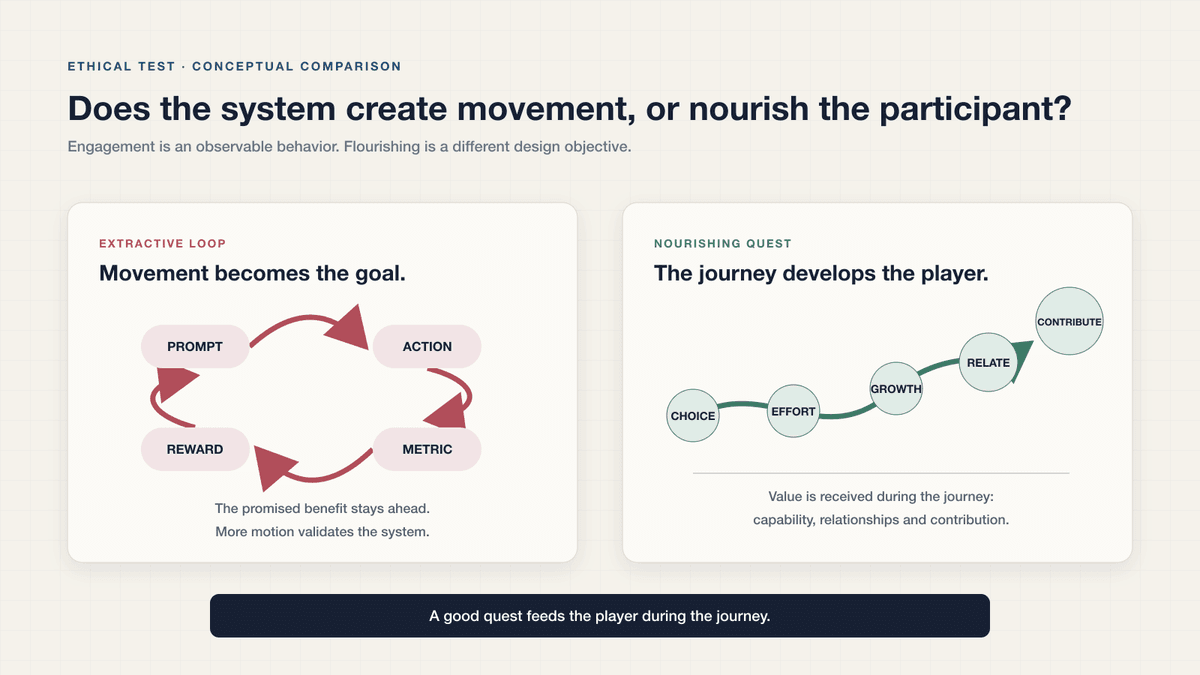
Think of a pig chasing a carrot on a stick. The carrot motivates the pig to keep moving, but the pig never receives it. Eventually the pig dies hungry.
According to the movement metric, the system works perfectly.
According to the pig, it is a disaster.
This is the ethical test I now care about: does the activity only produce movement, or does it nourish the participant? Is the promised benefit attainable? Does the system need the reward to remain out of reach so the user keeps running?
A good quest feeds the player during the journey. A harmful engagement system needs the carrot to remain out of reach.
The evidence supports caution. A meta-analysis of gamified learning found positive average effects on cognitive, motivational, and behavioral outcomes, but the studies were heterogeneous and results were less stable in higher-rigor work.[10] A 15-week classroom study found that badges and leaderboards reduced intrinsic motivation, satisfaction, and empowerment compared with a non-gamified course.[11] A meta-analysis of 128 experiments found that expected tangible rewards tied to participation, completion, or performance could reduce intrinsic motivation. Positive feedback behaved differently.[12]
The point is not that games or rewards are inherently harmful. The point is that engagement is not the same thing as flourishing.
This is not only a future risk. Researchers examining about 11,000 shopping websites found 1,818 instances of designs that coerced, steered, or deceived people into unintended decisions.[13] Regulators have documented difficult cancellations, hidden data choices, disguised advertising, and misleading charges.[14] Games make power feel fun. That makes the rules more important, not less.
The world does not preserve your build
Dungeons & Dragons helped me see another kind of game.
For me, D&D is not a closed product with one repetitive loop. It is an open social universe. A character can live across different campaigns. You look for tables to join, meet people, enter new worlds, and build a history through shared adventures.
I once described a campaign built around reincarnation. Each shorter campaign takes place in a different world with different rules. The character can lose their body, abilities, possessions, and status. Only memory persists.
That changes everything.
The world does not preserve your build. It preserves your memory.
Knowledge becomes the real meta-progression. By remembering previous lives, the character detects patterns, discovers the deeper rules of the universe, and eventually faces a moral choice: continue the cycle, use it to gain power, help others understand it, escape it, or destroy it.
That is the part of D&D I want to borrow for real life. We already move between campaigns: companies, cities, relationships, projects, communities, religions, games, and adventures. I do not think we need one permanent role or a universal score to make those moves add up. I want people to carry their own memory, learn from it, and decide what it means.
The memory belongs to the player. A Dungeon Master may ask for a summary to design a better campaign, but the player decides whether to share it. There is no automatic right to inspect the full archive.
I would trust a company that shows me how it works more than one that shows me nothing. I expect people may face a similar trade: share more context, get better-matched opportunities, stronger personalization, maybe better protection from AI. But I do not know how to stop that trade from becoming a penalty for staying private. If privacy costs someone safety or meaningful access, it is voluntary on paper and compulsory in practice.
That unresolved tension belongs in the design, not outside it.
Control without understanding becomes a performance
My failed AI delegation taught me that formal control is not enough.
When I no longer understood what the agents had built, I could still approve, reject, or interrupt their work. But why should the slower, less informed participant overrule the system merely to feel important?
Control without understanding becomes ceremonial approval.
Understanding without control becomes spectatorship.
A healthy human role requires both—or an honest acknowledgement that control has been delegated instead of pretending that an approval click makes the human sovereign. By control, I do not mean hand-approving every action. I mean the ability to set boundaries, stop high-risk behavior, choose whether to participate, and change the rules that govern future decisions. Execution can still be non-human.
I do not want every small experiment to wait for another human approval meeting. Low-risk, low-resource experiments can proceed within clear limits. When residual risk or required resources are high, the agent should pause for human consensus.
The executing agent cannot certify its own proposal. I want independent agents and simulations to attack it from different angles. People who genuinely enjoy this work can join the review. If nobody wants to, independent agents can still do the analysis instead of turning validation into compulsory human labor.
Five agents with different job titles are not independent if they all call the same model on the same infrastructure. The review layer should mix providers, deployment arrangements, and model families, including self-hosted and closed-source private models when they add genuinely different failure modes.
I have not yet resolved exactly which models must be open-weight. My current proposal is that systems producing engagement environments expose their models, prompts, objectives, and decision records. A separate review layer may need heterogeneous systems, potentially including private models. Open weights do not make a system safe, and the boundary between these roles remains unresolved.
And if a system can restrict someone or change their opportunities, it must give them reasons and a real way to challenge it. EU law offers narrower precedents: the GDPR provides safeguards for certain solely automated decisions with legal or similarly significant effects, while the Digital Services Act requires reasons and redress for specified platform decisions. These are precedents, not a universal guarantee for every algorithmic judgment.[16]
I do not have the final architecture. I just do not want one opaque intelligence designing the world and grading its own work.
Design constraints for a future worth playing
I do not have a complete political or economic system. I have constraints that I want to test.
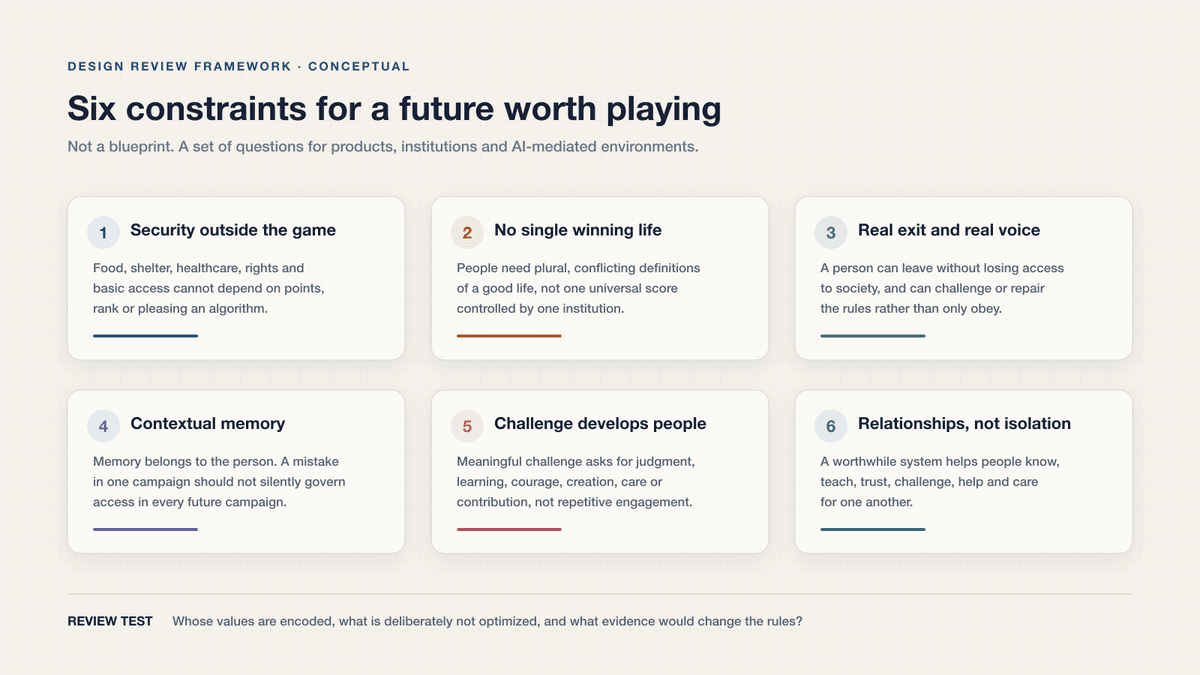
1. Basic security must sit outside the game
Food, shelter, healthcare, legal rights, physical safety, and basic access cannot depend on earning points or pleasing an algorithm. If losing the game means losing the necessities of life, participation is compulsory.
This is a design requirement, not a solved implementation. I have not yet defined the minimum safety, protection from AI, and opportunity floor owed to someone who declines personal disclosure. Until that floor is real, privacy may be legally optional but materially coercive.
2. There cannot be one winning life
A meaningful society must support conflicting definitions of a good life. Science, family, art, spiritual practice, entrepreneurship, competition, care, exploration, games, and a quiet life can all be legitimate campaigns.
One universal score would flatten that diversity and hand enormous power to whoever defines the metric.
3. Participation needs real exit and real voice
A person should be able to leave a community, platform, or quest without losing access to society. They should also be able to challenge or repair the system instead of choosing only between obedience and exile. Albert Hirschman's distinction between exit and voice remains useful here.[15]
4. Memory should not become a permanent public score
A person may remember everything without every institution receiving that memory. Data can remain contextual. A mistake in one campaign should not silently determine access in every future campaign.
People may choose transparency and receive benefits from it. The harder question is what minimum safety and opportunity must remain available to people who do not.
5. Challenge must develop the person
The most meaningful games ask for learning, judgment, courage, creation, care, cooperation, or contribution. Repetitive engagement designed only to keep someone occupied is not purpose. It is sedation.
6. Systems should create relationships, not only engagement
D&D becomes real when the character gives you a reason to find a table. A worthwhile system should help people know, teach, trust, challenge, help, and care for one another. A perfectly personalized solo experience may keep a person busy while making them lonely.
No system should pretend to be neutral. Every scoring rule expresses values. Designers should say whose values they are, what they refused to optimize, and what evidence would cause them to change the rules.
What Buddhism contributes, and what it does not
Buddhist practice shapes how I think about this problem. I am a practitioner, not a teacher or scholar.
I return to an early Buddhist concern that craving is an origin of suffering. I use this as a philosophical lens, not scientific support—and not as a rejection of every desire, ambition, or enjoyment.[17] A society can become materially abundant while giving people infinitely more sophisticated ways to want, compare, consume, and attach identity to status.
That is not liberation. It is the pig running faster on a more comfortable treadmill.
Mindfulness offers a philosophical contrast with attention capture: attention can be deliberately observed rather than engineered for compulsive capture.[21]
Buddhism does not provide an energy policy, constitution, economic model, or formula for allocating scarce land. Institutions still need rights, accountability, technology, and conflict resolution. I do not want to use Buddhism as decoration for a product. I want it to remain one of the traditions that challenges the assumption that more stimulation and achievement automatically create a good life.
Some meaningful quests may not provide fast feedback at all. In my writing about timely and timeless ideas, I realized that money measures timeliness better than timelessness.[22] A timeless project can keep the loop open beyond one person's life. Its satisfaction may come not from being remembered, but from becoming dispensable to something that continues without you.
A future worth playing needs room for adventures with no victory screen.
We can test the transition now
We do not need to wait for AGI.
Companies are already automating parts of writing, analysis, software development, support, management, and decision-making. In a field study of 5,179 customer-support agents, access to an AI assistant increased issues resolved per hour by 14% on average and by 34% for novice and lower-skilled workers.[18]
That is encouraging. It also raises the question that my own failure made personal: when AI makes someone more productive, does the person become more capable—or merely more dependent on a system they understand less each day?
I am building Self-Degree around a version of this problem. It assesses what a person understands, identifies gaps, and tries to deliver only the learning needed to close them. In UnVibe, I am experimenting with games that test whether developers understand code written with AI. Betabots uses independent AI users to test complete product journeys instead of trusting the implementation agent's own checks.
These are small experiments, not proof that I know how to design post-AGI civilization. They let me test pieces of the problem now: agency, knowledge, feedback, verification, and the difference between completing a task and understanding it.
Every organization adopting agents can ask:
- When AI automates a task, what understanding disappears with it?
- Can the affected person challenge the AI's answer or decision?
- Does the new system develop judgment or only increase output?
- Who can inspect the objective, prompt, model, and decision record?
- Are people free to leave without losing necessities?
- Does participation create real relationships and portable learning?
The transition will be shaped by thousands of decisions that look local and practical today.
What would change my mind
I may be wrong about the scale or timing of the transition. AI may transform jobs without making work broadly optional. Scarce infrastructure may remain concentrated enough that automation increases coercion rather than freedom. People may create meaning organically, making designed systems less important than I expect.
Gamification may also be the wrong language. Even carefully designed systems could crowd out intrinsic motivation, feel paternalistic, or turn normal life into endless measurement. Stronger answers may come from families, religions, local communities, democratic institutions, art, sport, or traditions that do not think of themselves as games.
I would revise this thesis if voluntary gamification repeatedly made people less autonomous, if communities rejected designed participation, or if plural institutions consistently outperformed explicit game systems.
I also have unresolved problems, especially around privacy. I expect transparent people and institutions to receive more trust and better AI support. I do not yet know how to prevent that market advantage from becoming coercion. Pretending the tension does not exist would reproduce the exact problem I am trying to solve.
This is not a utopian blueprint. It is a research direction and a personal mission.
The future should be more than comfortable
I do not want a future where AI runs everything while humans spend eternity consuming whatever keeps them calm.
I want difficult quests, strange experiments, strong communities, real freedom, useful conflict, and adventures worth remembering. I want people to have security without becoming passive, fresh starts without becoming ahistorical, and progress without being trapped inside someone else's score.
For years, I built systems designed to keep people participating. Now I am trying to build systems worth participating in.
We are teaching machines to operate more of the world. I want us to be equally serious about what kind of world they operate.
Sources
- International Labour Organization, Generative AI and Jobs: A Refined Global Index of Occupational Exposure, 2025.
- International Energy Agency, Energy and AI: Executive Summary, 2025.
- UNEP International Resource Panel, Global Resources Outlook 2024, 2024.
- Karsten I. Paul and Klaus Moser, Unemployment Impairs Mental Health: Meta-analyses, 2009.
- Liliana Winkelmann and Rainer Winkelmann, Why Are the Unemployed So Unhappy? Evidence from Panel Data, 1998.
- Kerwin Kofi Charles, Is Retirement Depressing?, 2002 working-paper version.
- Erik Lindqvist, Robert Östling, and David Cesarini, Long-Run Effects of Lottery Wealth on Psychological Well-Being, 2018 working-paper version; published 2020.
- Eva Vivalt et al., The Employment Effects of a Guaranteed Income: Experimental Evidence from Two U.S. States, revised 2026.
- Damon Jones and Ioana Marinescu, The Labor Market Impacts of Universal and Permanent Cash Transfers, revised 2020.
- Michael Sailer and Lisa Homner, , 2020.