Timeless vs Timely. Or how to die happy
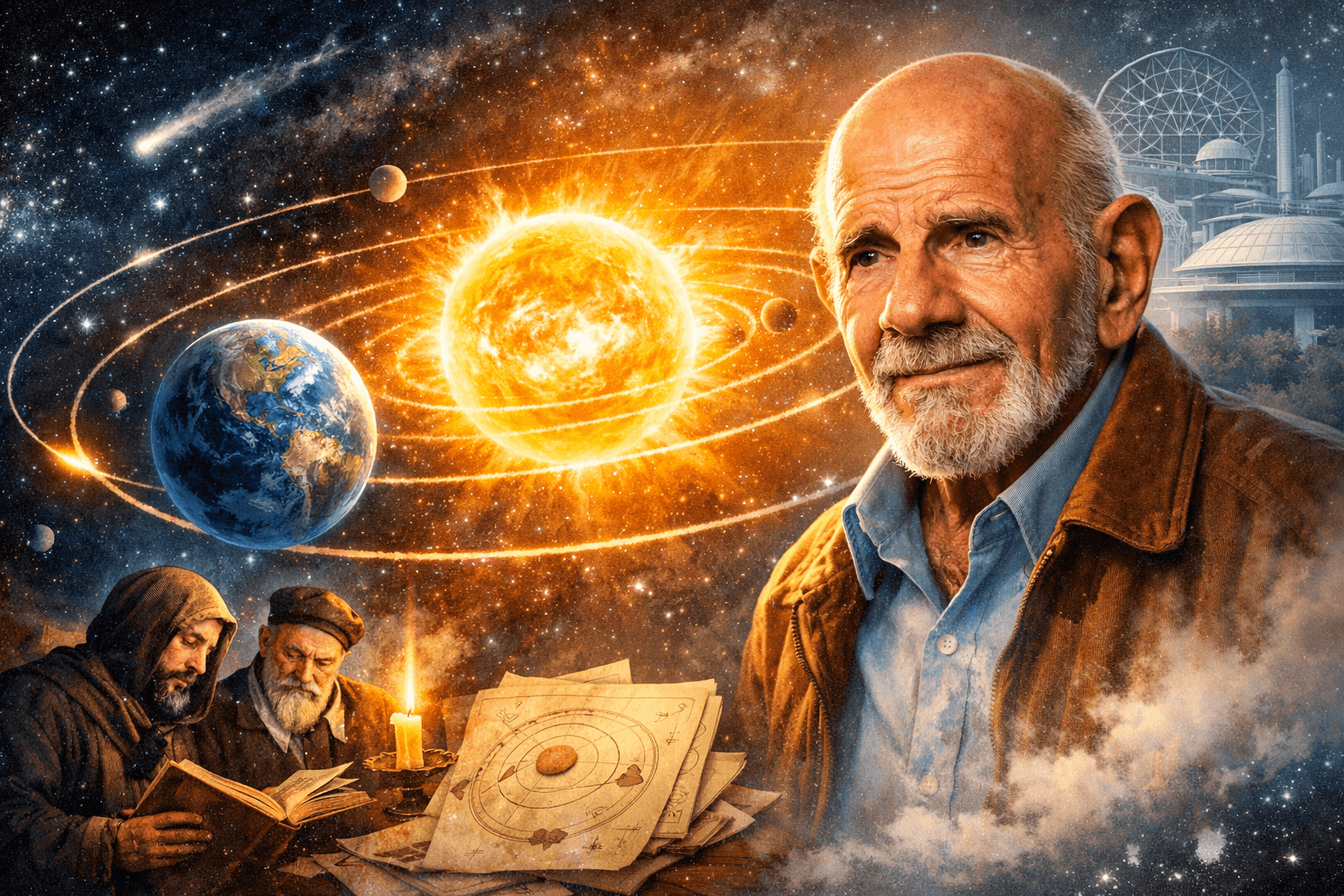
I watched the anime "About the Movement of the Earth" and I am not the same. I think this anime changed me, and I am still understanding in which way.
(LIGHT SPOILER ALERT) There was one scene that altered something fundamental in how I think about life and death. Badeni dies, and Oczy has an internal monologue about the afterlife.
Oczy had killed many people. He had also seen multiple people die their own deaths. All of them looked miserable and terrified. All of them were religious and believed in heaven. Yet none of them were ready to die.
There were only two people Oczy saw die happy: Badeni and the heretic they tried to save. Both denied the existence of heaven. Yet they died happy and satisfied.
It wasn't a special belief in the afterlife that made them die happy. It was belief in the timelessness of their ideas. Both were researching heliocentrism. Both played a role in passing those ideas to the next generation.
Heliocentrism was astronomical research attempting to prove that Earth isn't the center of the universe, but rotates together with other celestial bodies. It was considered heresy. People died for studying and developing this idea.
Yet they were ready to give their lives for something that could change the world long after they were gone.
The Modern Problem
Would this even be possible today? In a world where every idea is developed by hundreds of people across different countries, can you still find that feeling of necessity - that your specific participation matters enough to surrender everything?
I would argue that your satisfaction at death doesn't depend on the magnitude of your impact, but on the structure of the idea itself.
This is highlighted by Badeni's death. He didn't contribute to the idea directly. He simply led to someone else picking it up. His role was indirect, possibly forgettable. Yet he died satisfied.
So what kind of ideas make you satisfied to die for them? Must they be illegal? Must they change the world as we know it?
I would argue that what matters is whether the idea is timeless rather than timely.
The Distinction
Timely ideas operate on the surface of the present. They respond to immediate conditions. They offer feedback within your lifetime - you can see if they worked, if they were accepted, if they paid off.
Timeless ideas cannot be verified within your lifetime. They require a leap across time. You must trust that future people will complete what you started, correct your errors, carry what you couldn't finish. The loop does not close while you are alive.
The study of theology in the 15th century was timely - it addressed the concerns of that specific era. But particular ideas within theology might be timeless, depending on whether they could be settled or needed generations to unfold.
What made heliocentrism special was not merely that it was disruptive. Many disruptive ideas are timely - they challenge the present but resolve quickly. Heliocentrism was timeless because it was unprovable in its era. You could believe it, work on it, die for it, but you could not confirm it. You had to trust the future.
In the modern age, people don't go to jail for disruptive ideas in most countries. So would working on a disruptive idea give you the same satisfaction?
I would argue yes - if the idea remains unproven and unpopular. Only then do you experience the specific sensation of serving something that transcends your own verification. You become a participant in a conversation that will continue without you.
But here is the crucial correction: the satisfaction does not come from feeling important. It comes from feeling dispensable.
Against Importance
I keep wanting to write that timeless ideas make you feel like an "irreplaceable stepping stone." But Badeni wasn't irreplaceable. The heretic wasn't irreplaceable. If Oczy had died instead of Badeni, someone else might have picked up the thread. If that specific heretic had never existed, heliocentrism would have found other carriers.
The happiness comes not from uniqueness but from participation in something that doesn't need you. The idea continues whether you are remembered or forgotten. You are released from the burden of witnessing your own impact. You will never know if you were right. You surrender the need to know.
This is why timely ideas cannot provide the same satisfaction. They keep you alive in the wrong way—waiting for validation, monitoring returns, calculating legacy. The loop must close. You must see.
Timeless ideas let the loop stay open.
Money and Memory
I need to correct something I wanted to believe: that money measures timelessness. It doesn't. Money measures timeliness.
Timely ideas attract investment because they promise returns within investment horizons. They generate jobs, economies, measurable outcomes. Timeless ideas often generate negative ROI for generations. Investors are not foolish for avoiding them. They are simply playing a different game—one that requires being alive to collect.
Timely ideas make you rich. Timeless ideas make you happy.
"Remembered" is the wrong metric too. Badeni is not remembered by history. He is a minor character in a larger story. Yet he died happy. The satisfaction is not fame. It is orientation—facing toward something that extends beyond your death, regardless of whether your name travels with it.
If you want a well-put life, work on timely ideas. If you want to die happy, work on timeless ideas.
But working on timeless ideas is terrifying because you never know if you are right. You must see something others don't and trust something that remains unproven. If something is already proven, the idea has ripened. The potential for that specific surrender—the happiness of not knowing—may have passed.
Paradoxically, you must be willing to be wrong. What matters is not correctness but attempting the proof. The disruptive potential of timeless ideas satisfies even if the idea turns out wrong in the end. You are not afraid of error. You are afraid of never having tried to see beyond the present.
If an idea gains popular support, does it generate the same satisfaction?
I would say no. Widespread support suggests the idea has accumulated sufficient proof to convince those who encounter it. Timeless, unripened ideas remain disruptive and unproven. Naturally, they provoke skepticism. The loneliness is part of the structure.
Timeless Ideas of Our Time
I once participated in an organization called The Venus Project, founded by futurist Jacque Fresco in 1985. Its goal was researching socio-economic models beyond capitalism. Fresco had lived through the Great Depression. He had seen shops full of food while people starved outside. He witnessed capitalism's opposite face—one difficult to imagine from the relative stability of the 21st century.
Fresco believed money was the fundamental flaw. A sustainable society without war or poverty required moving beyond monetary systems.
Many hated him. They called him a terrorist, a communist, a destroyer of peace. He found followers anyway—volunteers across the world who contributed without payment. The organization ran entirely on volunteer labor. No one was building a career. No one was accumulating returns.
Studying Fresco's ideas felt like studying heliocentrism in the 15th century. The state could have easily imprisoned him—"this man is a communist." Yet it wasn't communism. It was something larger and unproven, something that might take generations to evaluate properly.
Fresco died in 2017. The project has largely faded. I do not know if his ideas were correct. And I hope to see them implemented or disproven. This does not invalidate the framework - it deepens it. Timeless ideas can still die. The heretics before Copernicus were not all "right" in ways history validated. Some were forgotten. Some were wrong about details. The satisfaction was never guaranteed success. It was the orientation toward something that might outlast them, regardless of outcome.
Another timeless idea I pursue: the dissolution of educational institutions as we know them. The best education is fully personalized and need not destroy family finances. Yet most countries regulate against it. You cannot simply take your child home and let them learn. You may be imprisoned.
The risk, the unpopularity, the inability to verify within one lifetime - these are not obstacles to the happiness. They are its conditions.
Conclusion
To identify timeless ideas, look for those that separate you from feedback. People work on them without payment not because they are saints, but because payment would require confirmation they cannot have. The ideas contradict common belief not for contrarianism's sake, but because they see something the present cannot yet process. They are risky not merely in consequence but in epistemology - you cannot know if you are right, and you will not live to find out.
If you work on these ideas, you may die happy.
Not because you were important. Not because you were remembered. But because you participated in something that continues without you. You surrendered the need to see the result. You trusted the future with your life's work.
The happiness is release. The happiness is not knowing.