Code Is Becoming Disposable. Your Engineering System Is Not.

By disposable, I mean replaceable implementation code, not disposable behavior, tests, or accountability.
A team I worked with used to take three to six months to deliver a big feature. Releases happened about once a month, and feedback or bug fixes could sit in the backlog for weeks. After we rebuilt the process around AI agents, a community platform was reimplemented in two weeks. Releases moved to every few days, and feedback that had sat for weeks started getting resolved within days.
The team also went from eight developers to two. The other six were laid off after they did not adopt the new workflow and continued writing most of the code manually.
This is one anonymized case from my experience, not a controlled experiment. I do not want the layoffs to become the whole story. But it is why I no longer see this as a five-year forecast. Teams can work this way now, and I believe the ones that redesign around agents will move faster than teams that add AI autocomplete to the same development process.
The operating model that follows is what I am proposing, informed by that experience. I am not claiming that every part of it already existed in that team or that one case proves the same model will work everywhere.
CTOs need to stop asking how AI can help their developers write more code. That question preserves the old organization. The better question is what an engineering team should become when writing code is no longer the scarce part of product development.
My answer is uncomfortable: engineers should stop spending their time writing implementation code. Agents should do that. Humans should spend their time deciding what to build, challenging proposed solutions, classifying risk, reviewing the changes that can cause real damage, and improving the system that produces the next change.
Autocomplete is not adoption
Most companies still treat an AI agent as a private tool. A developer opens an IDE, asks for a function, reviews the response, and closes the laptop. The agent belongs to one person and one session.
This can make an individual developer faster, but the company still works the same way. Work pauses when the developer disconnects. Context remains trapped in a local transcript. A colleague asks a question, the developer asks the AI, then pastes the answer back. Another developer repeats the process with another agent that knows nothing about the first conversation.
That is not an AI-native team. It is a traditional team with better autocomplete.
In January 2026, I wrote Vibe Coding Is Team Leading with AI Agents. At the time, I thought the main transition was from programmer to team lead: the human writes the brief, the agent implements it, and the human reviews the result.
I no longer think that goes far enough. It keeps the agent attached to one person and leaves the human as the implementation loop's permanent bottleneck. The next transition is organizational. The human becomes the control plane for a system of agents that can continue without one developer carrying every conversation.
An AI-native team treats agents as persistent participants in the development process. They run in the cloud, continue working across shifts, and communicate in a shared workspace such as Slack, Discord, Buzz, or an equivalent system. One developer can start a conversation and another can continue it. Everyone can see which tasks are active, what the agents proposed, where they disagree, and what evidence they produced.
The difference is organizational ownership. A private coding assistant makes one developer faster. A shared agent can make what the organization learns available to everyone.

A private assistant can accelerate one station while leaving the organizational production line unchanged. Generated editorial illustration.
Capacity stops following headcount
For most of the history of software teams, the default way to increase development capacity was to hire more developers. Capacity grew, but never as quickly as the org chart. Every additional person created more communication, coordination, onboarding, meetings, and dependencies. The tenth developer did not add the same independent capacity as the first.
AI-native teams have another growth mechanism. Their engineering capacity depends on three factors that keep improving:
- Models improve. The underlying agents become more capable at reasoning, implementation, review, and tool use.
- Harnesses improve. The system around the model gets better at planning, delegation, persistence, retries, verification, permissions, and recovery.
- Context improves. Every approved decision, type, test, document, conversation, and skill gives future agents a better understanding of the product and how the organization works.
These factors do not merely add capacity. They multiply each other.
Engineering capacity(t) = Base capacity × Model(t) × Harness(t) × Context(t)
A better model produces more value when it runs inside a reliable harness. The same harness becomes more effective when it has stronger product context. Better context also helps the team improve the harness and use new models faster. Each layer increases the return from the other two.
If models, harnesses, and context each improve by a persistent percentage over time, their product has an exponential form. I am not claiming that every team will follow one clean curve or that we already know the exponent. I am saying that engineering capacity is no longer tied mainly to adding people. It can compound as the whole agentic system improves.
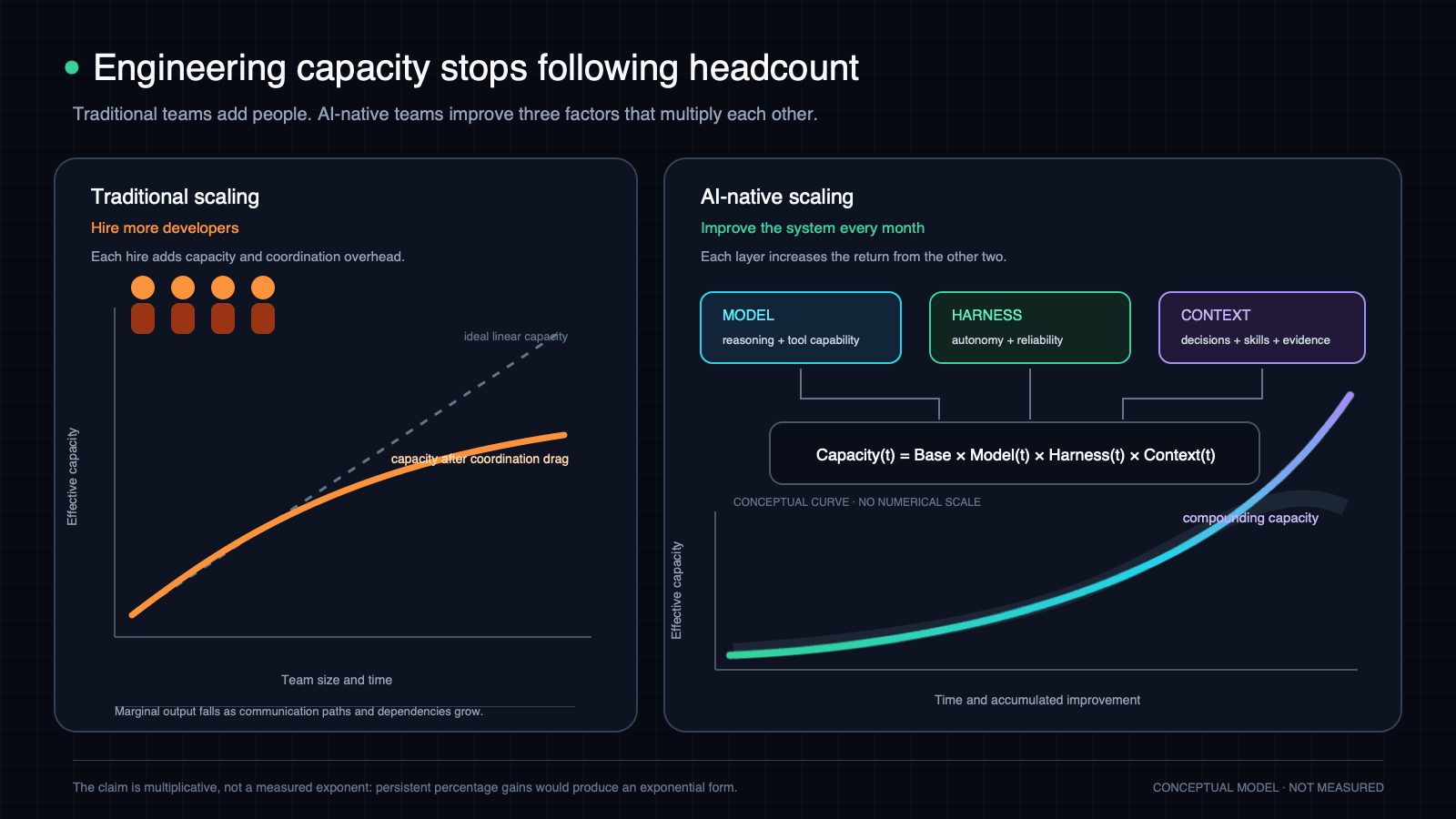
Conceptual model, not measured data. Open the image to view it at full size.
This is why waiting is dangerous. A team that adopts six months later does not start six months behind. It starts without six months of improved context, reviewed skills, hardened workflows, and experience integrating stronger models. The early team has been improving all three multipliers while the late team was still measuring individual developer productivity.
Code is becoming disposable
Infrastructure provides an established analogy. The Twelve-Factor App describes processes as disposable: they can start or stop at a moment's notice while the system is designed for robust deployment and recovery. Kubernetes similarly describes Pods as relatively ephemeral, disposable entities. Durability moves out of one running instance and into the specification and control system.
I think the same shift is starting to happen to code.
We have spent decades optimizing code for humans who may need to maintain it years later. We debate abstractions, naming, reuse, and whether the implementation is sufficiently elegant. This made sense when producing and changing code was expensive.
Agents change that cost. If an agent can regenerate a low-risk component quickly, long-term human maintainability becomes less valuable. Preserving an implementation for years may cost more than replacing it.
This does not mean correctness is obsolete. It means maintainability and correctness are no longer the same thing.
I am willing to sacrifice maintainability. I am not willing to sacrifice types or tests.
Types give an agent explicit context. They reduce ambiguity about the shape of the system and constrain what a valid change can do. Tests give the agent independent feedback. They tell us whether a new implementation still produces the behavior we approved.
The implementation can become disposable because the intent and proof remain durable.
We used to ask whether another developer could maintain this code in two years. AI-native teams should ask whether an agent can understand, verify, and safely replace it today.
Move durability up one level
If code becomes disposable, the system around it must become much stronger. You cannot generate software quickly on top of vague tickets, missing tests, stale documentation, and environments that only work on one developer's laptop.
This is the part of the shift I would not compromise on. If implementation becomes cheap, the surrounding system has to become more explicit.
The durable layer should contain:
- approved product intent;
- the alternatives considered and the reasons behind a decision;
- typed contracts;
- automated tests for product behavior, acceptance criteria, and known edge cases;
- current public and private documentation;
- shared agent skills;
- reproducible development and deployment environments;
- the evidence required to approve a release.
I do not mean 100 percent line coverage. A team can execute every line and still prove almost nothing useful. I mean that every declared behavior, every acceptance criterion, and every known edge case should have automated regression coverage. The full relevant regression suite should run for every release candidate.
Tests become executable product specifications. Types become machine-readable context. Documentation becomes part of the change rather than an optional cleanup task. Review agents should be able to inspect public documentation and propose updates to public or private documentation through CI.
The environment matters just as much. An agent should be able to create an isolated development environment with one action. The same candidate should be deployable repeatedly for automated end-to-end tests and manual verification. If setup still depends on tribal knowledge and a particular laptop, the agent does not have a reliable feedback loop.
Disposable code without this durable layer would produce disposable products.
Humans become the control plane
Moving engineers out of implementation does not remove engineering judgment. It makes judgment the main job.
For a substantial feature, an agent should prepare the PRD, possible UI and architecture variations, trade-offs, a recommended decision, risks, detailed acceptance criteria, and the verification plan. Humans should not accept the first plausible answer. They should discuss the alternatives with agents, challenge assumptions, add missing constraints, and approve the final direction.
The useful artifact is not a document pretending that the answer was obvious. It is a decision record. Future agents need to know what was considered, which option humans selected, and why.
Agents should also recommend the type and risk of every ticket during triage. Humans should confirm that classification before implementation. This is where a large share of senior engineering time should go.
The final word remains with humans. Agents make the initial proposal because producing options is cheap. Humans own the decision because they remain responsible for the consequence.
Stop reviewing every change as if it could kill the company
Manual review does not disappear, but it should depend on risk.
A high-risk ticket should be isolated to the smallest possible change. A senior engineer should review it line by line, inspect the tests and failure modes, verify it in an isolated environment, and explicitly authorize the release.
A medium-risk ticket should receive a brief implementation review plus behavioral verification. The human should confirm that the affected surface, tests, and observed result match the approved ticket.
A low-risk ticket should be judged mainly by its acceptance criteria and result. If the change is disposable, reversible, and covered by reliable regression, line-by-line review wastes the exact human attention the system is supposed to preserve.
The agent recommends the risk level. A human confirms it. The company needs explicit rules for reversibility, data access, financial impact, security, customer visibility, and the size of the affected surface so that a dangerous change cannot quietly enter the low-risk path.
This is the new allocation problem for engineering leaders. Senior attention should follow possible damage, not the number of lines an agent produced.

Human attention should increase with possible damage, not with the quantity of generated code. Generated editorial illustration.
Put agents in the room where decisions happen
Engineering discussions should happen in a workspace visible to humans and agents.
Agents can prepare competing opinions on a ticket. Humans can question them in the same thread. If the agents disagree, the disagreement should stay visible instead of disappearing inside a private reasoning process. Humans can then make the decision, and the agents see the decision and its rationale directly.
This breaks a wasteful communication chain: I ask you, you ask your AI, then you paste its answer back to me. Everyone should be able to speak to the relevant agents directly. The resulting work should live in one organizational workspace where other people and agents can reuse it as context.
Cloud hosting makes this persistence possible. The agent is no longer attached to a laptop or a single employee's working hours. It can keep executing, report progress, ask for a decision, and hand the conversation to another human when necessary.
The communication platform is therefore part of the engineering system. It holds the visible record of proposals, disagreement, approval, and evidence.
Shared does not mean universal access. Agents should see only the channels, repositories, and data required for their roles. Secrets, customer data, employee data, and confidential client material need least-privilege controls, redaction rules, and explicit retention and deletion policies. A conversation should not become permanent agent memory merely because it happened in a shared workspace.
Every human correction should compound
In the model I am proposing, human feedback should not disappear after a single ticket.
A senior engineer corrects an agent. The agent produces a better answer for that ticket. A week later another agent makes the same mistake in another repository, and another human writes the same explanation again.
I want every useful correction to improve the system that creates future work.
When a human says "remember that," the agent should save the instruction immediately on its own branch. The conversation should not stop for a governance ceremony. Once per day, agents should review what they learned and turn durable corrections into proposed changes to a shared skill library.
Those proposals should arrive as pull requests. Humans review them, resolve contradictions, reject accidental preferences, and approve the lessons that should become global. Once merged, the relevant agents use the improved skill.
This may become one of the largest uses of human engineering time. That is a good trade. Fixing one generated implementation improves one feature. Improving a shared skill changes how the organization approaches every similar feature that follows.

The valuable correction changes the factory that produces future work, not only the defective output in front of the human. Generated editorial illustration.
The warning for CTOs
The advantage of an AI-native team does not come from generating code a little faster. It comes from a tighter feedback loop: agents propose and implement, tickets surface risk, humans verify consequential changes, and the system preserves decisions, tests, context, and corrections.
A competitor that builds this system will not simply deliver the same roadmap with fewer keystrokes. It will learn and release at a different cadence.
Keeping eight developers busy writing code is not safer if a two-person team with a stronger agentic system can ship a large feature in two weeks, release every few days, and resolve feedback before it becomes backlog sediment.
CTOs who treat AI adoption as a choice for individual developers are avoiding an organizational decision. They need to redesign roles, triage, review, environments, documentation, and learning around agents now.
The warning for engineers
Writing code manually can still feel like real engineering. It is concrete, difficult, and familiar. Carefully maintaining abstractions can feel responsible.
That attachment can also make you slow at the part of the job that is losing scarcity fastest.
The engineers who remain valuable will not be the ones who can produce the most code without AI. They will be the ones who can turn an unclear product request into a good decision, recognize hidden risk, challenge a plausible architecture, define behavior precisely, evaluate evidence, and improve the agents that do the implementation.
This is not a comfortable warning. In the team I described, people lost their jobs. I do not think engineers can protect themselves by dismissing that outcome as hype or by using AI only when it fits their old workflow.
The implementation is becoming disposable, but human judgment is not. That judgment has to move into the workflow, become visible, and improve the system. Otherwise it remains private opinion instead of becoming an organizational capability.