The Bet Should Not End When It Settles
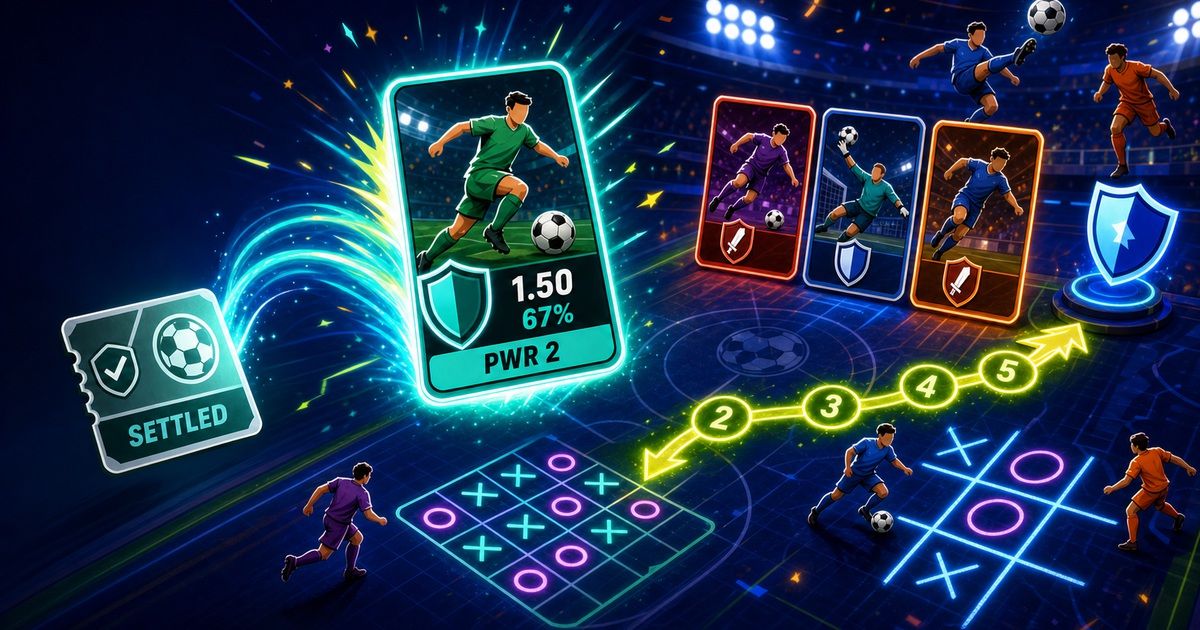
A proposal for turning settled bets into persistent game pieces.
A sportsbook puts enormous meaning into one moment and almost none into what follows.
You study the match. You notice something in the odds. You make a prediction. You wait. For a few hours, that bet carries tension, hope, doubt, and the possibility that you saw something other people missed.
Then it settles.
Your balance changes. The bet moves into account history. The next transaction begins as if the previous one never happened.
I keep seeing the same waste in betting products. A decision can hold someone's attention for hours, then collapse into an account-history row the moment the result becomes known.
I once launched a loyalty program that worked exactly as designed and still failed. The mechanics awarded what they were supposed to award. What I had not designed was how people would discover the program, where it would live inside the product, what would bring them back, and who would keep it alive after launch.
That failure made me suspicious of loyalty systems that sit beside the real product as isolated reward features. The settled-bet problem is another version of the same mistake. We create an intense experience, record the transaction, and discard almost everything that made it meaningful.
We keep asking what reward should follow a bet.
I think the better question is: what can the bet become?
A settled bet could become a card, tile, move, collectible, or resource inside another game.
Games preserve what happened
Games rarely throw away every meaningful action.
A battle gives you equipment. A match changes your rank. A quest opens another part of the world. A card you earned three months ago may become useful when a new combination appears.
Betting products usually do the opposite. In the loyalty systems I have worked with, the bet is often reduced to points, cashback, or progress toward another bet. Its individual history does not create another decision.
I am proposing a meta-game above the fixed-odds product. The first game is predicting an event. The second is deciding what to do with the history those predictions create.
By persistent, I mean that a piece survives settlement and a break as a gameplay state. It remains usable in later game modes without requiring another wager to keep it alive, while remaining subject to deletion requests, retention limits, legal holds, and safety restrictions. Social history can persist too: a private league record, a board shared with a friend, or a tournament title the player chooses to display.
The financial event still ends at settlement. The game object does not.
First, separate play from money
There is a dangerous version of this idea. If every new bet creates another card or another chance to rescue a streak, the meta-game becomes a disguised instruction to wager more.
Calling the reward non-monetary does not solve that. People compete for ranks, collections, and status without cash being involved.
The rule must be simple:
A bet can become strategically valuable inside the meta-game, but the resulting piece can never carry monetary value back into gambling.
Its sport, market, odds, and result should remain meaningful. That is what prevents the card from becoming a generic collectible wearing a football skin. But no card can change future cash odds, payouts, stake capacity, or the result of another bet.
This still creates an obvious risk: more bets can produce a larger collection, and longer-odds bets can feel strategically desirable because their cards have more power. I do not want to hide that behind the word "non-monetary." Stake size must never affect a card. A playable hand should remain small, cards should not expire as a gameplay mechanic, and taking a break should never destroy progress. No task, notification, ranking, or recommendation should tell someone to place another bet, increase a stake, or choose longer odds to improve a hand. If collection depth, card power, or social status increases betting frequency, stake size, long-shot selection, or loss chasing, the mechanic has failed.
The meta-game must also inherit the product's safety controls. Age and jurisdiction eligibility, consent, marketing suppression, affordability and risk controls, self-exclusion, account restrictions, breaks, time limits, and other interventions must pause or hard-disable the game rather than leaving a route around them.
With those boundaries in place, Passive Draft is the first idea I would test.
Passive Draft
Every settled bet becomes a card and carries its real details into the game: sport, event, market, decimal odds, and result. Under this proposal, the in-game activation chance is set to one divided by the decimal odds: a 1.50 card gets roughly 66.7%, while a 4.00 card gets 25%. This is a transparent game formula, not a claim about the event's true probability, and it deliberately does not model bookmaker margin.
Shorter-odds cards activate more often with less power. Longer-odds cards activate less often with more power. A player can build a reliable low-power hand, build around rare high-power activations, or combine both. The exact power curve would need balancing, safety testing, and compliance review before implementation.
Before a match, each player chooses three cards. Before every round, the player assigns each card to Attack or Defend. Both formations are locked and then revealed.
The match resolves automatically across three rounds using the same reusable hand, while allowing the formation to change between rounds. The settled result stays on the card as history; the game does not replay it. Each round instead rolls the activation probability derived from the source odds.
Each card occupies one of three lanes. If both cards Attack, each successful activation deals its own attack damage. If both Defend, neither deals HP damage. If an activated Attack faces a Defend card, it deals damage only when its power beats the defender. All three lanes are always occupied. The exact mapping from power to damage remains a balancing variable rather than a solved rule.
Each player begins with 10 HP. Reaching zero ends the match immediately. If both players survive three rounds, the player with more HP wins.
This is meant to feel closer to a tiny auto-battler than a sportsbook promotion. The setup fits on one screen. The first test is whether three cards, two assignments, and three rounds create enough strategic depth. Three football cards might unlock an All Football bonus. A mixed hand may sacrifice synergy for a better balance of reliable defenders and volatile attackers. A player can choose Defend, Defend, Attack for stability or Attack, Attack, Attack and accept the risk.
Match progression should stay inside Draft. It might unlock another formation, a new synergy path, or cosmetic card treatment. It cannot improve the monetary conditions of an actual bet.
The bet does not merely decorate the card. It determines how the card behaves.
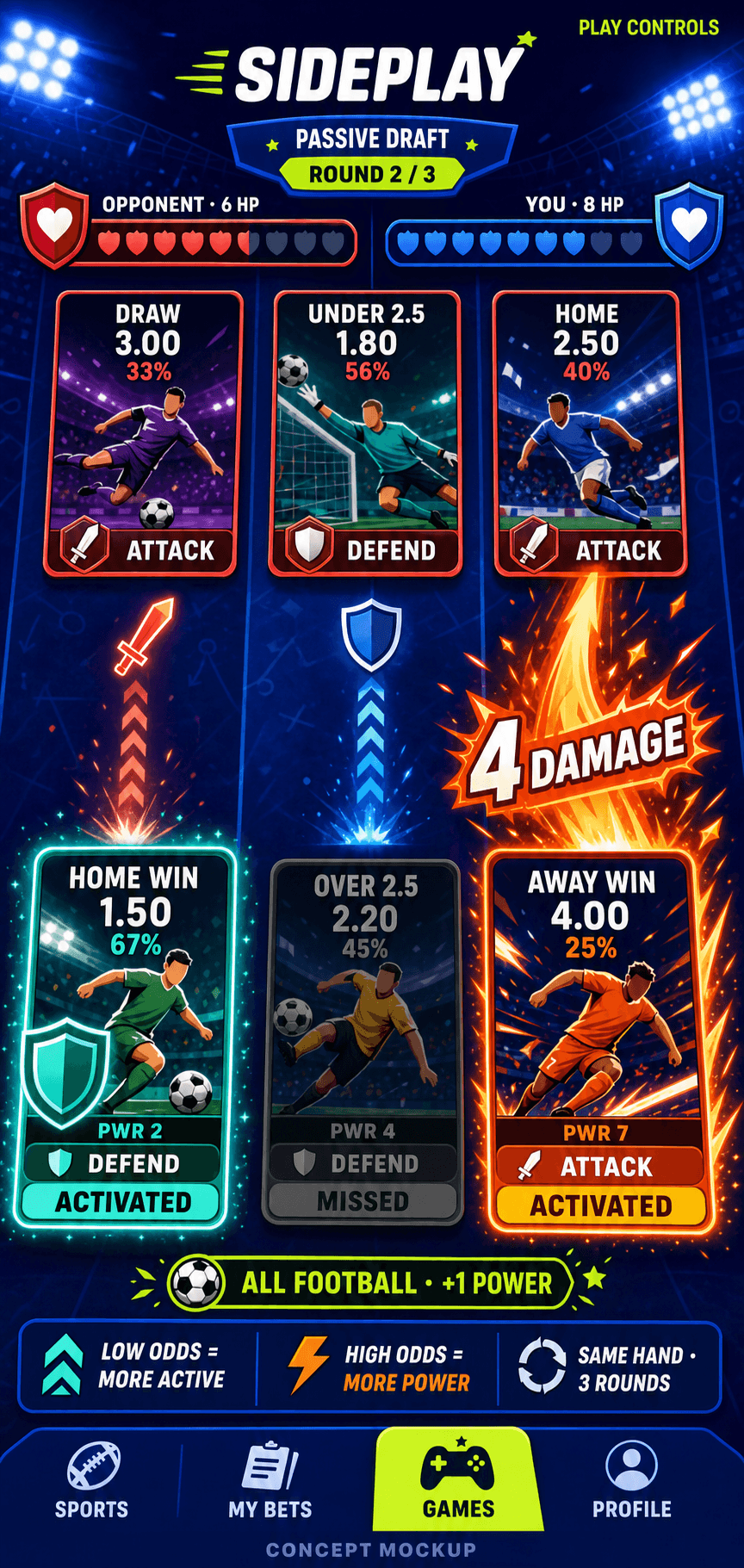
Passive Draft: three settled bets become one reusable hand. Lower odds activate more often with less power; higher odds activate less often and hit harder.
Three variations on the same idea
Passive Draft tests composition. Three smaller experiments test arrangement, opposition, and the ethical boundary of streaks.
Bingo Boom: arrangement
Bingo Boom gives the player a 4x4 board. As predictions enter the game, the player chooses which open cells they should occupy. A completed row creates progress inside the board.
My original idea rewarded a row of losses with a free bet. I reject that version. A losing row should not produce a recovery reward. Instead, every board can begin with the same repair token, issued before any outcomes are known, which the player may spend on one failed cell. The board does not expire. A fixed allotment of non-monetary game inputs can provide a complete path without turning sixteen cells into a wagering quota or creating free-bet value.
The interesting decision is where to place each piece and when to spend the repair, not how quickly to create sixteen bets.
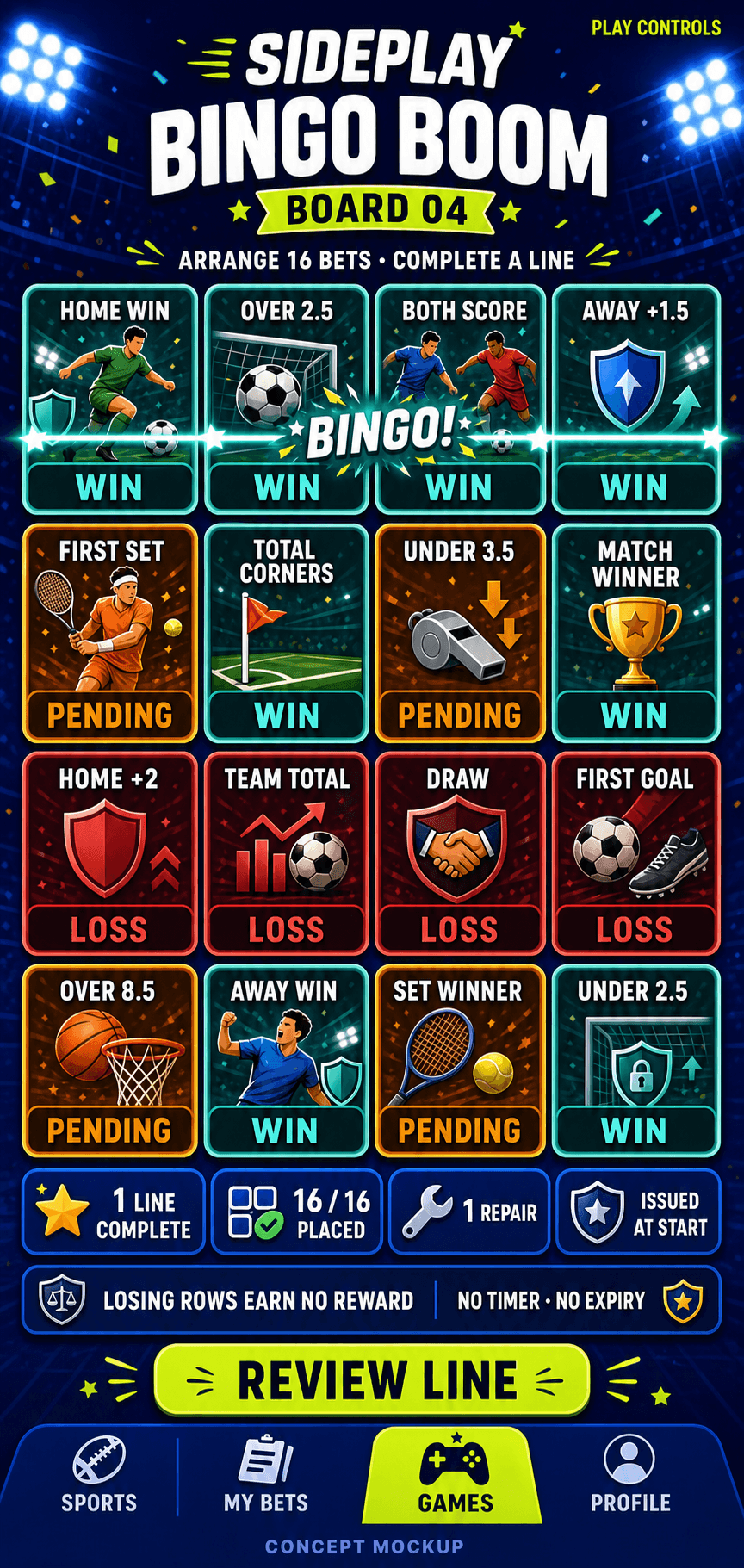
Bingo Boom: predictions become a persistent 4x4 board with no countdown or expiry.
Betting Tic-Tac-Toe: opposition
Two players enter a shared 3x3 board and place pieces from inventories they already hold into chosen cells. No additional wager is required to make a move. When a piece's underlying prediction settles, a successful piece claims its cell. If both players succeed in the same cell, it reopens while the match remains active. If both fail, neither advances.
The familiar board may reduce the tutorial burden. The test is whether it still produces real choices: Do I take the center, block a line, or save a flexible piece for later? Friends could create private leagues and tournaments, but profiles, wagering history, and results should remain private unless the player chooses to share a specific board or title.
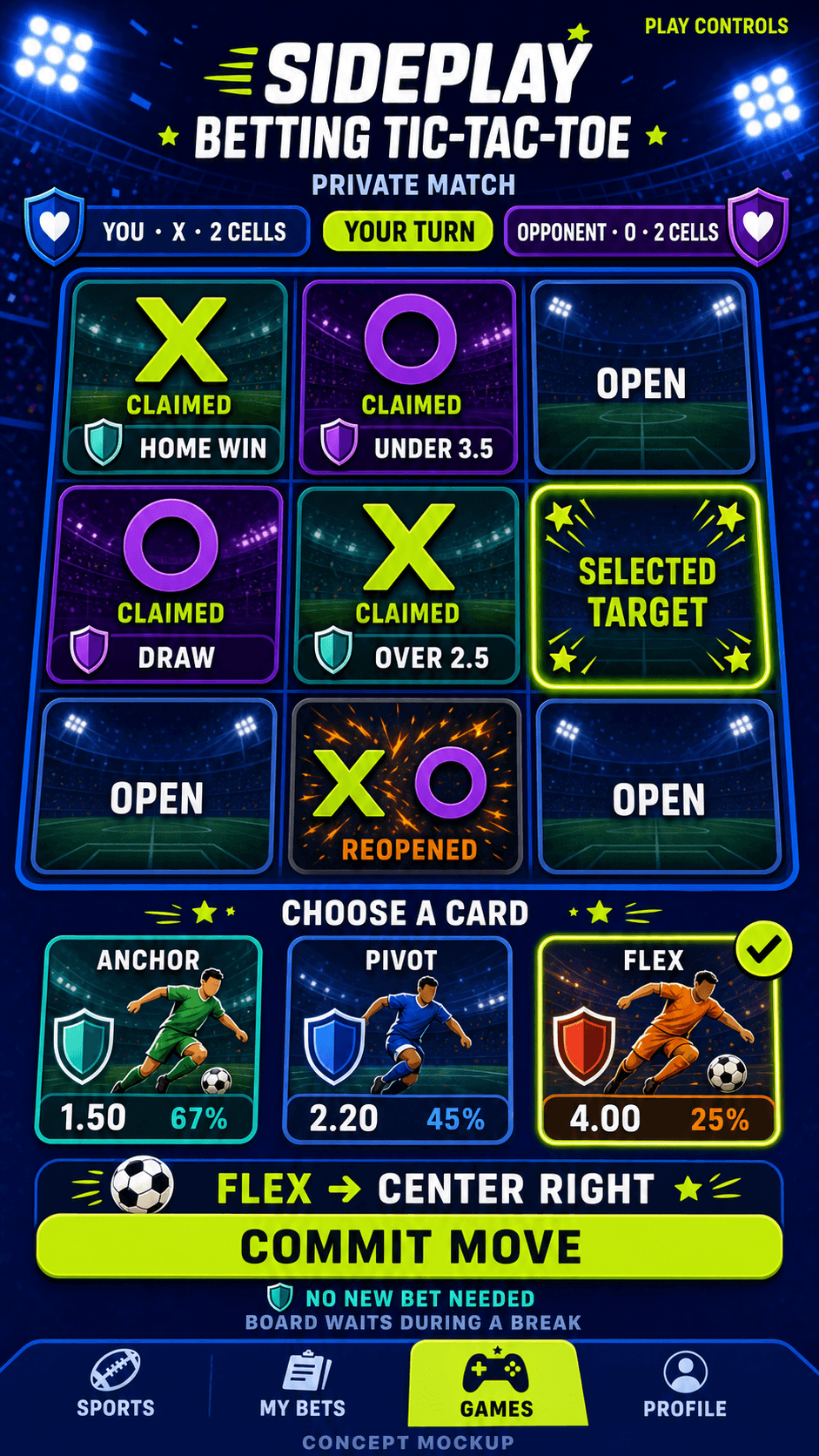
Betting Tic-Tac-Toe: existing pieces become moves on a shared board without requiring another bet.
PlaceStreak: a boundary test
My original PlaceStreak idea borrowed the claim-or-crash tension of crash games. A player would grow a chain and claim it before an unexpected result reset the progress.
I include it as a boundary test, not as a recommendation. If its tension depends on wanting to wager again, fearing a break, or recovering a loss, the mechanic has failed.
A version worth testing would use only a fixed batch of non-monetary game picks that cannot be converted into cash, odds, stake capacity, or free-bet value. Previously earned progress remains banked. There is no countdown, expiry, loss reset, or way to extend the batch through wagering. If removing those pressures also removes everything interesting about PlaceStreak, I would discard it.
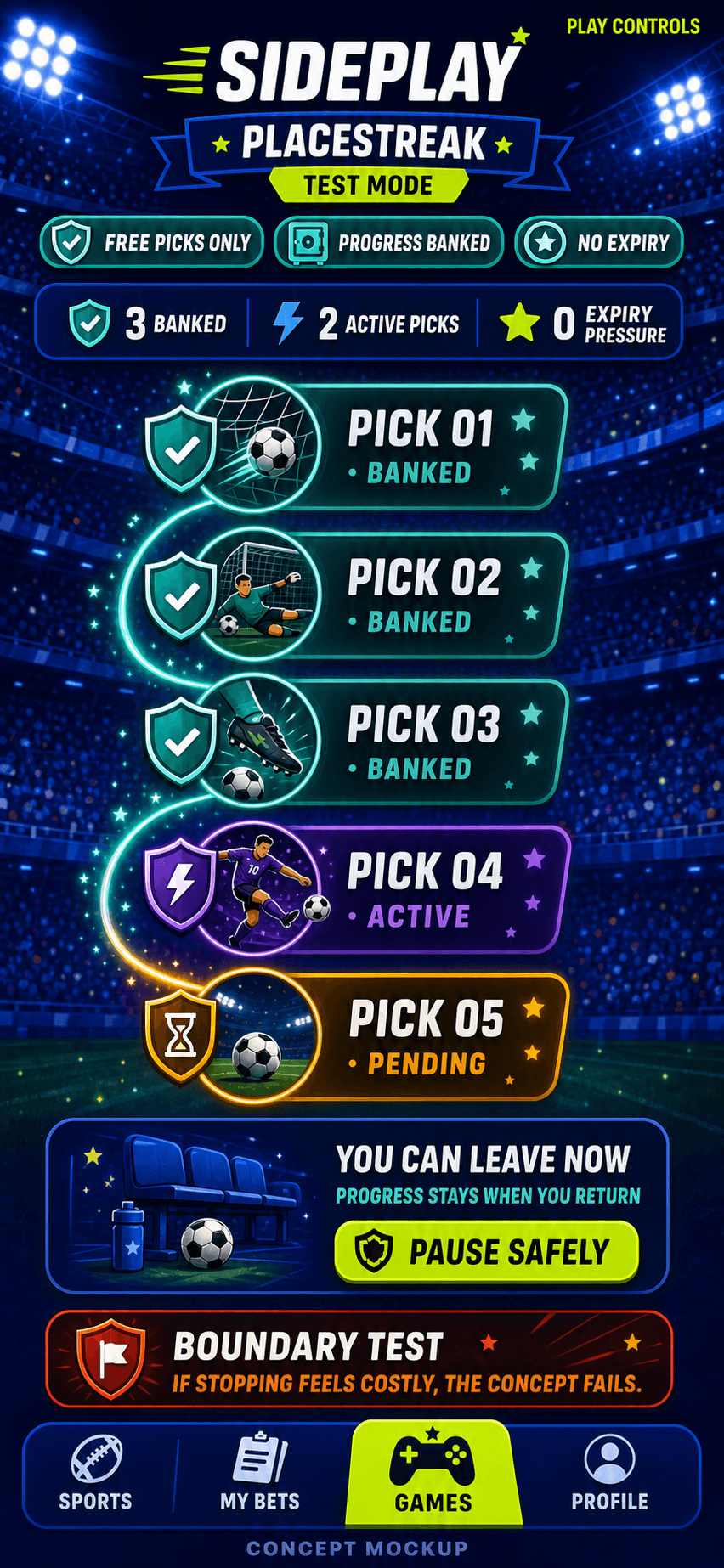
PlaceStreak as a boundary prototype: free picks only, banked progress, no expiry, and an explicit discard condition.
Connect the games without connecting the money
The larger opportunity is to let progress move between meta-games without letting game power leak back into monetary gambling.
A player might earn a Bingo repair by completing a Draft challenge that requires no new wager. A Tic-Tac-Toe tournament could open a new formation in Draft. A seasonal title could remain as a cosmetic identity without granting an advantage in the next season.
The cards can preserve real betting details and become mechanically different because of them. The boundary works in the other direction: no card, synergy, wildcard, or tournament reward can change the odds, stake, payout, or settlement of a real bet.
This still leaves room for player agency. People can choose combinations, organize private leagues, select approved rule modifiers, and develop strategies the product team did not anticipate. User-created content is optional. Meaningful choice is not.
The social layer needs stronger privacy than "private by default." The product should minimize what it retains, define deletion periods, and offer access, correction, export, and deletion controls. Meta-game data should not drive friend discovery, marketing, or targeted reactivation. Any use by affordability, responsible-gambling, AML, or KYC systems should be purpose-limited, governed separately, access-controlled, and auditable. Sharing must be granular and player-initiated, without exposing underlying stake, account, or risk data by default.
What would count as failure
I do not know whether these mechanics would create durable loyalty. They have not been built, user-tested, economically modeled, safety-tested, or reviewed for compliance.
A real experiment would need a holdout or phased rollout, safety measures defined before commercial metrics, and rollback thresholds set in advance. The operator should measure play separately from gambling exposure and harm per exposed user. That includes deposits, stakes, session duration, loss-chasing indicators, limit changes, taking breaks, self-exclusion, complaints, and support contacts.
The experiment should stop if the meta-game increases harmful behavior, makes breaks feel costly, pressures restricted users, or turns social competition into higher gambling exposure.
The World Health Organization warns that gambling can cause financial stress, relationship breakdown, mental illness, and suicide. Any real test would require responsible-gambling, privacy, eligibility, legal, and jurisdiction-specific review. This article does not assume an operator, license, jurisdiction, or legal classification. It is product exploration, not legal or compliance advice.
The first test
I would start with Passive Draft because the transformation is easy to understand: decimal odds set activation probability, longer odds buy more card power, and three settled bets become a reusable hand.
The product test is whether three cards, two positions, three rounds, and 10 HP create enough strategy without adding complexity. The safety test is whether the collection gives completed bets a second life without motivating additional gambling.
If the game cannot give a settled bet another decision without creating another reason to wager, I would drop the idea.
Source
- World Health Organization, Gambling, 2 December 2024.