Progress Has Gravity: The Force That Saved My Life - and Keeps Me From Finishing

Learning to leave the wrong path took me out of Ukraine before the invasion, beyond an engineer-only identity, and into startups. Then leaving became my habit.
A few weeks before Russia’s full-scale invasion, I left Ukraine.
I did not know exactly what would happen. I was scared enough to move, while many people I knew stayed. Their choice was understandable. They had jobs, homes, routines, families and years of effort holding them in place. Leaving did not feel like moving forward. It felt like throwing a life away.
Then the circumstances changed, brutally and all at once. The same roots that had made a life feel secure made escape harder.
I do not claim that recognizing a psychological pattern predicted the war, or that I know what would have happened to me if I had stayed. I only know that I managed to release one future before it became a cage. That decision changed every chapter that followed: Poland, Germany, the United States, India, Thailand, Dubai, Techstars, startups, friendships and adventures I could not have planned from Kyiv.

A flight I photographed on 13 February 2022, eleven days before Russia’s full-scale invasion.
I have a name for the force I escaped: progress gravity.
The longer we move in one direction, the more mass that direction acquires. Skills. Salary. Reputation. Friends. An apartment. A professional identity. A story that explains who we are. None of these is a chain on its own. Together, they begin to pull.
Eventually, continuing feels natural even when the world has changed. Starting again feels like destroying evidence that our previous years mattered.
The first times I escaped
I felt the same pull in my career before I had a name for it.
I had spent years becoming an engineer. I was good at it. That made the obvious future simple: become even better, earn more, collect a stronger title, repeat.
But the work had begun to feel strange to me. I could spend an hour deciding what should be built, then spend weeks implementing a plan whose interesting decisions had already been made. This happened even when I was building products from scratch. The ratio remained: a little creation, then a long mechanical grind.
I felt like a factory worker with a better chair.
At the same time, I believed more of that implementation would eventually be automated. Today AI is absorbing much of the repetitive work I was afraid of. I still work with engineering, and engineering remains part of who I am. But I am grateful I did not let it become the edge of my identity. I wanted to decide what should exist and why.
So I accepted a product-management job that paid less than the engineering role I already had. On the old scoreboard, this was an obvious loss. Fewer points. Lower salary. Less use of the expertise I had spent years accumulating.
Inside, it felt like air entering a room.
Later I did it again. I accepted roughly one-quarter of my previous salary to become a startup cofounder. Again I traded a visible, defensible form of progress for something uncertain: ownership, creativity, responsibility, the chance to build a life that could surprise me.
Those choices worked. Perhaps too well.
They taught me that I could cut a rope and survive. They taught me that a step backward on one scoreboard could move me forward on a larger map. They filled my life with places, people and stories I would never have reached by continuing along the safest line.
They also taught me to enjoy the cut.

One of the chapters that followed: Techstars Sports Accelerator.
When escape becomes a habit
There is a particular pleasure in a new beginning. A new product has no disappointing metrics. A new hobby has no plateau. A new relationship has not accumulated difficult conversations. A new city has no routine. Every fresh path contains all its possible futures at once.
Then possibility becomes work.
The product needs distribution, not another feature. The hobby demands repetition after improvement slows. The relationship requires staying through discomfort. The city becomes ordinary. This is the point where progress gravity becomes visible to me - and where I often reset it.
For years, I called that open-mindedness. Sometimes it was. Sometimes it saved me. Sometimes it was avoidance wearing the clothes of freedom.
My public portfolio gives the uncomfortable number. In roughly the last year, I started or added ten new projects or frameworks: Rachkovan.com, DnDate, AI Startup Factory, SOCOS, UnVibe, BetaBots, WorkInPublic, BeSimple, Uncle Yev and Unicup. Several became real products. None received the sustained go-to-market effort that would tell me what it could become.
I wrote a lot. I built a lot. I launched very little.
That is not a portfolio strategy. It is a pattern.
The mechanic that once helped me leave Ukraine in time now risks making my life mediocre in a quieter way. I can remain permanently promising. Always beginning. Always learning. Always one new progression system away from the difficult middle of the previous one.
A person who never questions the path may spend a life becoming excellent at the wrong thing. But a person who questions every path never becomes excellent at anything.
Expertise has its own gravity because it requires staying after novelty disappears. So do companies, books, friendships and love. Anything meaningful eventually asks us to repeat ourselves. Anything successful eventually becomes less exciting than the moment when it was still pure possibility.
The ability to leave is not freedom if I cannot choose to stay.
The save file
I understood progress gravity before I could explain it.
As a child, I played Asterix & Obelix XXL for about a year and a half. I was close to finishing it when my mother deleted the game and erased my save.
I tell the story as crying for seven days and seven nights. Childhood memory may have stretched the calendar, but the grief was real. I sank into what I remember as depression. Reinstalling the game did not help. The world was still there, but my journey through it was gone. Starting from zero felt impossible.
That memory is why achievements that ignore real history feel insulting. If a customer has visited your store twenty times, do not introduce a “visit 100 times” achievement and show 0/100. The interface is telling them their previous loyalty never happened. Start them at 20/100.
Loyalty researchers have measured a smaller version of the same feeling.
Give one customer an empty card with ten spaces. Give another a card with twelve spaces, but stamp the first two as a welcome bonus. Both customers still need to buy ten coffees. The economics are identical.
The second card feels different. It says: You have already started.
In experiments by Joseph Nunes and Xavier Drèze, people who received that artificial head start completed the card faster. Related café research found that customers bought more frequently as they approached a free coffee. Academics call these patterns the endowed-progress effect and the goal-gradient effect.
The names matter to researchers. The feeling matters to everyone else.
An empty bar asks whether I want to begin. A nearly full bar asks whether I am willing to lose what is already mine.
Progress does not live in the bar. It lives in the person.
Temu never wants you to feel at zero
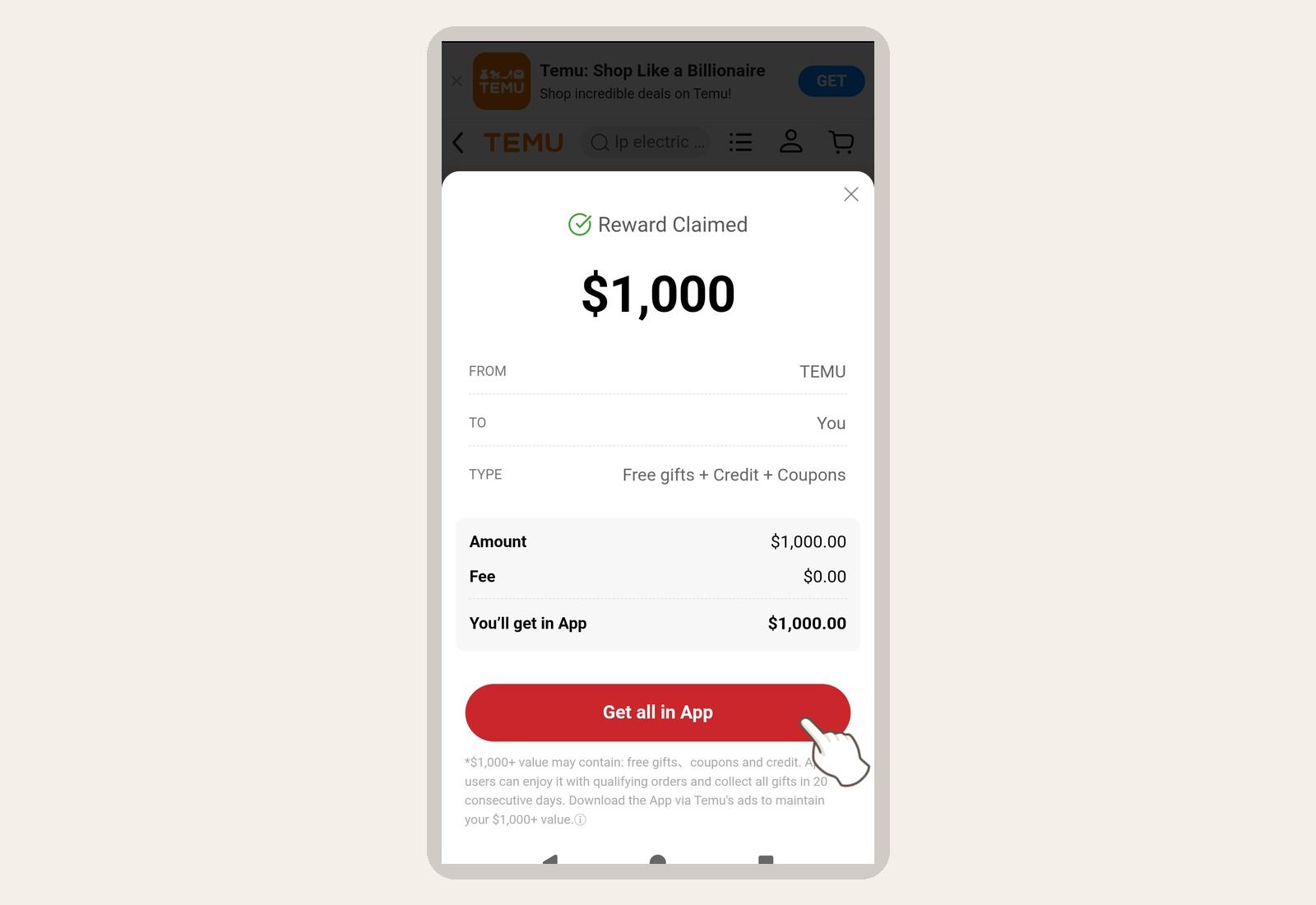
Real Temu promotion screen shared with J.D. Hodges. It says “Reward Claimed” and $1,000, while the fine print describes free gifts, coupons, credit, qualifying orders and 20 consecutive days.
Temu pushes this principle until it becomes theatre.
In my own use, I have repeatedly seen promotions that begin by granting almost the entire apparent target. The currencies and numbers change. Based on what I remember, one version displayed something roughly like this: I opened at 1,900 out of 2,000, with only 100 remaining. The interface valued the almost-completed reward bundle at approximately $5,700.
Then I discovered that collecting the last 100 points could require spending another $300. A timer said I had two days. For me, walking away no longer felt like declining a $300 purchase. It felt like throwing away rewards the interface said were already almost mine.
The emotional arithmetic felt absurd but effective: spend $300, or “lose” roughly $5,700.
In my experience, finishing or abandoning one promotion did not end the pressure; another promotion appeared. The final points could split into fractions, referrals or further conditions. What looked like a finish line became another corridor.
I consider the design brilliant. I also consider it dangerous.
I cannot claim this interface pattern caused Temu’s growth. No public evidence isolates it. In 2024, however, the European Commission and the CPC Network notified Temu of practices they considered in breach of EU consumer law, including fake discounts, pressure selling, forced gamification, and false claims about limited supplies or deadlines. BEUC’s 2024 report separately documented concerns about manipulative interfaces and reward conditions.
That is the ethical border. Progress can reveal a real route, or it can make a hidden route feel nearly complete. The screen may look almost identical. The difference is whether the remaining work is true.
If you design loyalty, you are designing gravity
A loyalty system is not only a table of rewards. It changes what people feel they have already begun, what they believe they own, and what they cannot bear to lose.
The most useful rule is simple: do not erase honest progress.
If you launch achievements, apply them to behaviour you can verify from the past. If a customer has completed twenty qualifying visits, show twenty. If you introduce a quest, use genuine previous actions as a head start instead of manufacturing an imaginary gift.
The experiment is worth running. Suppose a customer has already made $900 in eligible deposits or purchases. Instead of introducing a new “deposit $100” quest at 0/100, test a $1,000 quest that truthfully begins at 900/1,000. The next action is economically similar, but the second version recognizes a journey already underway. Measure entry, completion and incremental value against a holdout. Then check complaints, opt-outs and whether the effect survives after the reward ends. Faster completion alone may only move spending forward.
The $900 must be real historical behaviour. If the interface invents it, the experiment stops being retroactive recognition and becomes synthetic pressure.
A new customer has no history to recognize, but you can still test an honest promotional head start. In one variant, let the customer spin a welcome wheel and receive 900 promotional points. Disclose upfront that reaching 1,000 - and unlocking the stated reward - requires a qualifying $100 deposit or purchase. Compare first-action conversion with a version that starts at zero, then measure repeat behaviour, withdrawals or refunds, complaints and 30-day value. Do not treat the 900 points as a $900 gift unless they can genuinely be redeemed as such.
In regulated or high-risk products, this experiment belongs behind affordability controls, deposit limits, self-exclusion, age and jurisdiction checks, and a review of whether the reward creates disproportionate pressure. Conversion is not permission to harm the customer.
Tiers can use the same idea. Instead of forcing every new member to begin at the bottom, test a transparent promotional Level 2. Let the customer experience its benefits, then disclose that maintaining it requires at least one qualifying app visit each week. Compare engagement and durable value with a start-from-zero control. Give clear reminders and a grace period before downgrade. A surprise demotion is not motivation. It is a broken promise.
Leaderboards need closeness of a different kind. Position 56,897 is not a goal; it is a reminder that the game belongs to someone else. Put people in smaller, relevant cohorts where progress is plausible - but disclose the cohort, period and comparison basis. “Top 10% among new players this week” can be motivating. Pretending it means “top 10% globally” is manipulation.
Quests should reveal the route before a person enters. Collections should disclose rarity. Streaks should have grace and recovery. Community goals should stop moving when the community approaches them.
The objective is not to make a customer unable to leave. It is to make worthwhile progress easier to feel.
The harder form of open-mindedness
We are born into identities before we can choose them: Ukrainian, American, Thai; Christian, Buddhist; a member of a family, class, town or political tradition. Later we accumulate more: programmer, founder, teacher, gamer, traveller, partner, parent.
It does not happen overnight. We follow the same rules and repeat the same rituals for years, sometimes decades. Eventually an identity stops feeling like something we do. It becomes something we are. Its gravity grows until imagining another self feels like betrayal.
I used to think open-mindedness meant noticing that pull and letting it go when circumstances changed. I still believe that. In a world changing as quickly as ours, the ability to release an obsolete identity may become one of the most valuable skills a person can have.
Societies have progress gravity too. We preserve institutions after their purpose disappears. We inherit traditions no one chose. Some are harmless and beautiful. Others survive mainly because generations of people have already suffered to maintain them. Pain becomes evidence that the ritual must matter.
Sometimes I imagine what would happen if millions of people could see that pull without mistaking it for truth. Perhaps societies would become faster at dropping rules that no longer protect anyone. Perhaps we would spend less time defending identities and more time responding to reality.
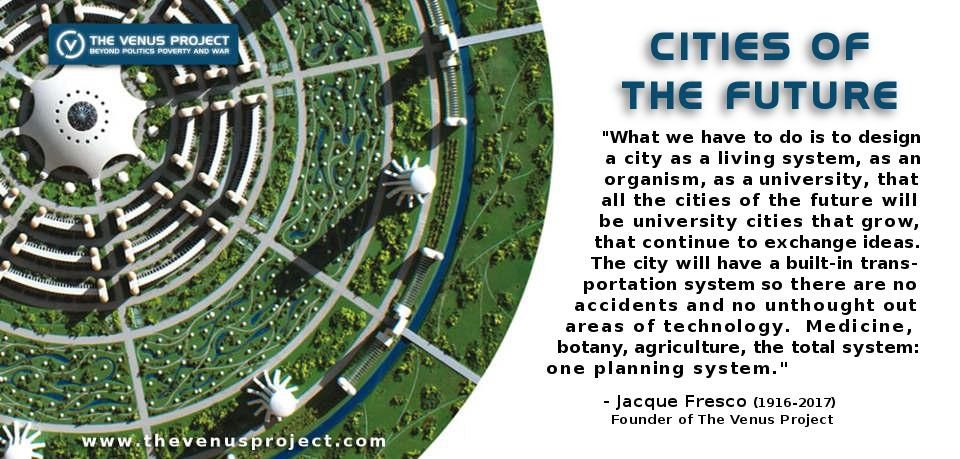
Jacque Fresco’s circular-city proposal for The Venus Project, an example of redesigning society from first principles rather than preserving inherited systems.
That is my utopian thought. Human beings are not about to transcend progress gravity, and marketers are not about to stop using it. Nor should every use disappear. A visible path can help people finish something valuable.
So use the force - but understand what you are making heavier. Give people credit for real progress. Make the remaining conditions visible. Help them reach a finish line they chose. Do not invent a fortune they will supposedly “lose” unless they obey you.
But I missed the second half.
Open-mindedness is not permanent escape. It is the ability to see the pull clearly enough to choose. Sometimes the honest choice is to leave. Sometimes it is to remain after the fantasy of a fresh start arrives.
I am trying to learn the difference now.
I ask myself whether the destination has actually become wrong, or whether I have merely reached the part where progress is slow and public. I ask whether new evidence changed the decision, or whether a new idea simply gave me relief. I ask what would happen if I gave the current path one serious year instead of another ingenious week.
My next project cannot be project number eleven.
It has to be finishing one of the ten. Giving it a real go-to-market. Staying long enough for customers - not imagination - to answer me. Allowing the boring middle to become depth instead of interpreting every weight as a cage.
Progress gravity saved me by teaching me that I could leave.
Now I need it to teach me something harder:
when not to.
Sources
- Yev Rachkovan’s public portfolio, inspected 8 August 2026
- Kivetz, Urminsky, and Zheng, “The Goal-Gradient Hypothesis Resurrected”
- Nunes and Drèze, “The Endowed Progress Effect”
- European Commission and CPC Network, Temu consumer-law concerns
- BEUC, “Taming Temu”