I Lost My Home. Then I Stopped Looking for One.

I left Ukraine looking for freedom. Two weeks later, the full-scale invasion began and the choice to return disappeared. It took me years to consider that the rootlessness I was fighting might also be teaching me something.
I had lived my whole life in Ukraine. Then an opportunity to travel appeared, and I left almost overnight on my first international journey. Two weeks later, the full-scale invasion began.
I left because I wanted freedom. Then the invasion made that freedom feel different. Returning was no longer a simple choice I could make whenever I wanted.
I did not literally lose every member of my family or every friend. I lost the ordinary world in which they were near me. I lost the assumption that home would remain available whenever I became tired of traveling. What began as a trip became a life I could not simply undo.
For years, I treated that life as an unfinished problem. Somewhere there had to be a city where I would finally belong, a community that would keep me, or a relationship that would make movement unnecessary. I changed countries, but the pressure traveled with me.
Recently I watched a video by a digital nomad who had spent seven years traveling the world. He admitted that freedom had become loneliness. He did not feel at home anywhere. He did not belong anywhere.
I understood him. But I have started to see the same life differently. Nomadism can become avoidance, consumption, or an endless search for a better place. It can also force a modern person to practise non-attachment.
Stop looking for a better place to sit
In Thailand, I spent time visiting Wat Pah Nanachat, a Buddhist monastery in the forest tradition of Ajahn Chah. I stayed nearby rather than living inside the monastery, but I went there to practise and listen.
At one point I asked a monk where I could find a better place to sit. The answer was already inside the question. My problem was not the place where I sat. My problem was that I kept looking for a better one.
That habit was larger than meditation. I had been doing the same thing with countries, work, relationships, and my own identity. I kept assuming peace existed in another arrangement of the world.
During that stay, I wrote down a sentence that became a useful summary for me: wanting things to be different from what they are is the source of the struggle. It was my own note from practice, not a quotation from a sutta.
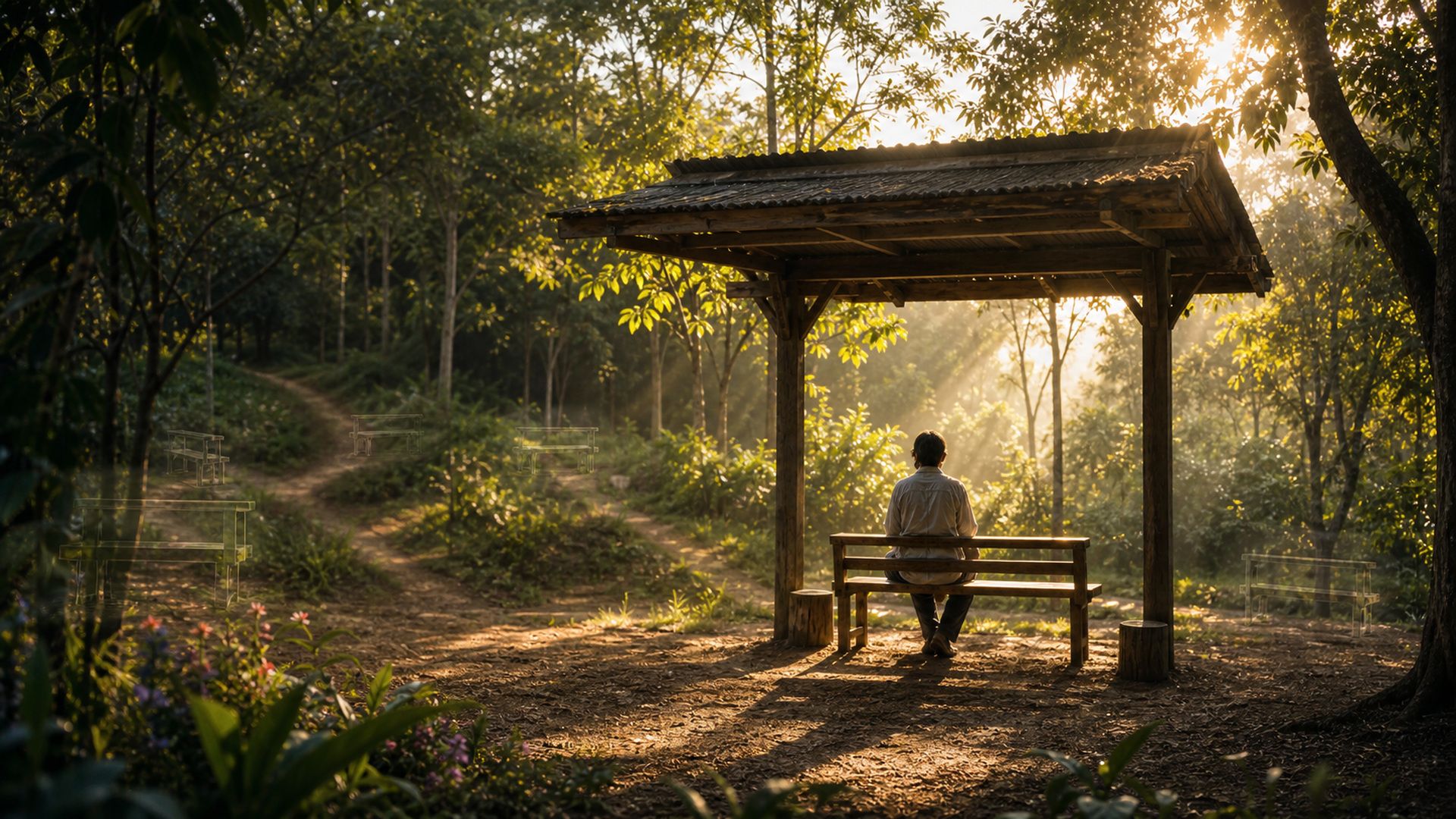
This does not mean accepting injustice, refusing to act, or pretending that war and separation do not hurt. It means seeing the extra layer of suffering created by insisting that my current life is a mistake that must be corrected before I can live it.
My rootlessness was painful. Fighting reality every day did not give me roots. It only made pain the organizing principle of my life.
The luck of having no cows
In the Dhaniya Sutta, a cattleman describes everything that makes him secure: his household, earnings, shelter, and herd. The Buddha answers that he has no need for earnings, no cattle, and has broken his bonds.
At the end, Māra says that people delight because of their children, cattle, and acquisitions. The Buddha answers that those same acquisitions also become reasons for grief.
This is easy to misunderstand as an attack on family, love, or responsibility. I do not read it that way. The problem is not caring for a cow. The problem begins when the cow becomes mine, and my peace becomes dependent on never losing it.
Possession creates borders in my mind. Once something becomes mine, I start protecting it and fearing its loss. I do not mean that nobody should own a home or care for a family. I mean that I do not want my peace to depend on keeping any of it.
If I own nothing, nothing owns me.
I have no friends, yet everyone is my friend
The same pattern appears in friendship.
I noticed how easily my existing friendships could harden into an image of what a friend should look like. A friend shares certain interests, has a familiar personality, comes from a comprehensible background, communicates in an expected way, and offers a recognizable form of loyalty.
Then we meet someone new and compare them with the image. Is this my kind of person? Could they enter my circle? Do they qualify as a friend?
The category protects us, but it also filters people before we have encountered them.
The word friend carries an unwritten contract too. A friend should answer. A friend should remember. A friend should invite me, defend me, stay in contact, and prove that the relationship matters. When those expectations are not met, connection turns into disappointment or resentment.
When I say I have no friends, I do not mean I am incapable of intimacy. I mean I am trying to stop making people pass an invisible test before I let myself feel close to them.
I have no friends, yet everyone is my friend.
This does not mean everyone receives equal trust. I do not trust a stranger the way I trust someone who has shown up for me in a crisis. I do not owe every person the same thing. Conduct matters. Promises matter.
But connection can come before qualification. Love does not have to begin as a claim of ownership.
How travel removed the foreigner
I did not always feel this way.
While I lived in Ukraine, nearly all my friends were Ukrainian. Before I knew anything about someone, I sometimes felt discomfort or distrust around people I had learned to see as foreign. Media stereotypes could make particular religious identities feel threatening to me.
My image of Muslims, for example, came largely from terrorist characters in films. I had almost no ordinary contact strong enough to compete with that image. It was prejudice. Distance and films gave it material, but I carried it as if it were intuition.
Travel did not remove it through one beautiful conversation. Reality simply made the stereotype harder to maintain.
Over years of ordinary contact with Muslim people, the category stopped explaining the individuals in front of me. Living in Dubai made those encounters part of daily life. Separately, conversations with Pakistani residents about their work, migration, families, and problems widened my sense of how much a label can miss.
“Muslim” stopped arriving before the person.
This does not mean that I now carry a positive stereotype instead of a negative one. There is no single Muslim life, Pakistani life, Ukrainian life, or nomadic life. The point is that nationality and religion no longer decide whether I can connect with someone.
The moment you have a country, you have foreigners.
I am Ukrainian. I love Ukraine. I grieve what was done to it. But I do not want that love to require the rest of humanity to feel foreign.
I have no foreigners.
The moment you have a family, you have outsiders.
I have a biological family and people toward whom I carry real responsibility. Letting go of ownership does not erase them. It changes what their existence means. I do not need to withhold warmth from everyone outside that circle in order to prove that the circle matters.
I have no outsiders.

Non-attachment is not loneliness
There is an obvious objection to all of this. Universal friendship can become a flattering name for never allowing anyone to know or need you. If everyone is equally close, perhaps no one is close at all. If I reject every expectation, I can escape not only possession but responsibility.
Buddhism does not ask us to pretend relationships are irrelevant. In the Upaḍḍha Sutta, Ānanda suggests that admirable friendship is half of the holy life. The Buddha corrects him: admirable friends, companions, and colleagues are the whole of the holy life.
This sutta presents admirable friends, companions, and colleagues as central to the holy life. I take that as a warning against turning non-attachment into isolation.
The line I am trying to hold is simple, even if living it is not: commitment without possession.
I can care deeply without demanding permanence. I can make promises without asking another person to complete me. If this philosophy makes me less available, less reliable, or less honest, then I am using it to hide.
That is the test.
The blessing I was trying to escape
Nomadism is not automatically liberation. A person can cross the world while carrying the same fears, prejudices, and hunger for validation into every country. Movement can be another way to avoid sitting still.
For years, that was part of my life. I kept searching for a place that would remove the feeling of not belonging.
Wat Pah Nanachat did not give me a new home. It helped me question the demand that one home must cure me.
I may live in one city for years. I may build long relationships. I may choose commitments that narrow my freedom. Non-attachment does not require permanent movement. It means I no longer want my peace to depend on owning the city, the relationship, or the future.
I left Ukraine looking for freedom. The invasion changed what that choice meant, and I still do not know how to make a clean story out of it.
I lost something real: the ordinary certainty that home was waiting for me. But years of moving also made it harder to divide people into my people and everyone else.
I do not need to own a place before I can be at home there.